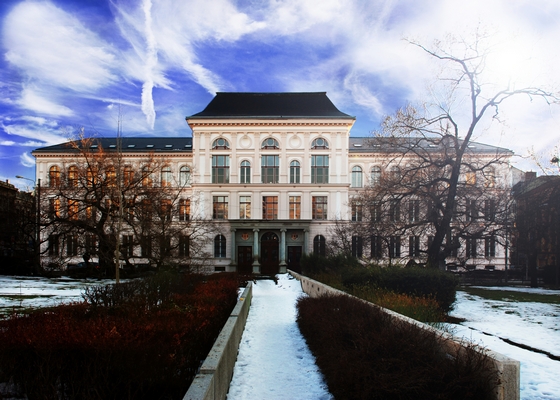

Moving from place to place, living in an eternal makeshift situation, such was the fate that accompanied the Ústí Museum for exactly 135 years of its existence. In 2011, the adversity of the stars finally broke and the precious collections on the history of the Ústí nad Labem region rested in the dignified premises of the first real building of the Municipal Museum.
The museum in Ústí was established in 1876 and opened its first exhibition in the “Golden Boat” hotel in Hrnčířská Street (today the seat of the Na Předmostí restaurant). But in a few weeks it had to go elsewhere and then elsewhere again…, during the first ten years it moved eight times. The number of collection items and the prestige of the museum were increasing and the need for its own museum building seemed necessary. In 1914, the city approved the construction of a new municipal museum in Palachova Street near the Municipal Parks. However, the First World War thwarted the intention and in the post-war distress, the honorable gesture of the leading Ústí industrial family, the Wolfrums, to donate the castle in Trmice for the needs of the museum seemed to be salvation. However, even the aristocratic residence did not become a permanent home. On the one hand, it soon ceased to be sufficient for the needs of the museum, and on top of that, a long-term lack of maintenance brought the chateau to the brink of total devastation in the 1960s. In 1971, another promise came to build a specialized building of the city museum, which was to be built on Mírové Square. However, a temporary solution was again preferred, so in 1972 the museum staff moved into the neo-Renaissance school building next to the theater. At first, they coexisted in one building with schoolchildren, and then the main post office occupied the former classrooms. The museum only played the role of a tolerated tenant. With the move of the post office at the end of the 20th century, the question of a new use of the historical building arose. There was a chance to finally establish a dignified city museum and also a harbinger of another, perhaps the last move.
In 1876, his imperial grace probably had no idea that the Ústí city councillors had just built a new burgher school. But on a historical scale, it was a particularly important project in Ústí. The monumental school building conceived in the Neo-Renaissance style was the most representative building in the wider area at the time. The town, not having its own town hall, had a magnificent hall designed for the school for council meetings and other prestigious gatherings. This was also reflected in the decoration, including rich painting of the walls and ceilings with allegorical motifs, complemented by gilding made of gold leaf. The school, which was expanded in 1897 by an extension into a closed block, laid the foundation of the Ústí nad Labem “Ringstrasse”, i.e. an address full of magnificent public palaces modelled on Vienna. Other buildings soon followed: the Post Palace (1900), the Municipal Theatre (1909) and the Municipal Library (1912) in the neighbourhood.
When Emperor Franz Joseph I visited Ústí nad Labem on June 17, 1901 during his trip to the Kingdom of Bohemia, there was no doubt about where the imperial audience with the leading inhabitants of the city would take place. The place of this exceptional event logically became the building of today’s city museum. And so, in memory of this event, the Imperial Hall received its magnificent name. It is a nice coincidence that the reopening of the museum after the general reconstruction took place almost exactly 110 years after the imperial visit. Thanks to the unexpected discovery of the murals and their precise restoration, the public was able to see the Imperial Hall for the first time as Franz Joseph I saw it.
What does the Ústí Museum hide?
The museum in Ústí nad Labem has existed since 1876. Until 1901, it was taken care of by the Ústí nad Labem Industrial Association, then it was administered by the Museum Society until 1939. In the following decades, the museum belonged to the competence of various levels of state administration or self-government. Since 1986, the museum has been subordinated to the political representation of the statutory city of Ústí nad Labem, of which it is a contributory organization. At present, its museum collections and book collections are the property of the city of Ústí nad Labem. In its work, the museum is governed by legal regulations for the management of movable cultural heritage, for the care of museum collections and for public libraries.
At present, the Museum of the City of Ústí nad Labem manages about 200,000 registration numbers of museum collection items and their sets. It manages about 60,000 book units in the specialized museum library, which is also in charge of about 2000 volumes of old prints and manuscripts.
The largest collections include natural science collections, which were also created at the end of the 19th century. They contain numerous and important collections documenting mainly the nature of northwestern Bohemia, the Bohemian Central Uplands and the Ore Mountains. We can find thousands of geological samples of minerals, rocks and paleontological evidence. We can also find here a herbarium, especially entomological collections, and zoological collections with a number of interesting preparations are attractive. In connection with the construction in the historic center of Ústí nad Labem in recent decades, archaeological collections have also grown. Historical collections contain, for example, tens of thousands of photographs, negatives, slides or postcards. There are also military collections, which are extraordinary, for example, for a set of weapons and military material from the period around 1813, when the Battle of Chlumec took place. Due to the industrial character of the region, there are numerous technical collections. Fine arts and crafts are represented, for example, by historical furniture, glass, a set of late Gothic wood carvings or landscape painting of the 19th and 20th centuries. Both in terms of the number and quality of collections, the Museum of the City of Ústí nad Labem is one of the most important regional museum institutions in the Czech Republic.