

Velehrad is one of the most important pilgrimage sites in the Czech Republic. It is closely connected with the tradition of Cyril and Methodius. The cult of the Slavic apostles, who are together with St. Benedict co-patrons of Europe, makes Velehrad a place that goes beyond the borders of our state in importance.
According to archaeological findings and historical research, the political and administrative centre of the Great Moravian Empire and the metropolis of its first archbishop St. Methodius can be connected with the wider area of Uherské Hradiště, the Old Town with its surroundings and Velehrad.
According to archaeological findings and historical research, the political and administrative centre of the Great Moravian Empire and the metropolis of its first archbishop St. Methodius can be connected with the wider area of Uherské Hradiště, the Old Town with its surroundings and Velehrad.
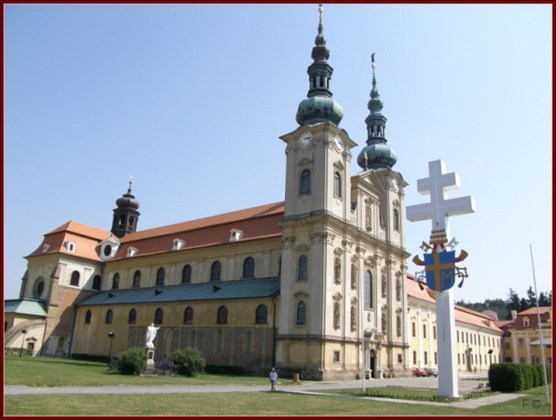
The beginnings of today’s Velehrad date back to the beginning of the 13th century, when the first Cistercian monastery in Moravia was founded here by the Moravian margrave Vladislav Jindřich in the Romanesque style with the influence of early Gothic. The extensive complex together with the convent church of the Assumption of the Virgin Mary was completed in the forties of the 13th century. Its later fate: burned down by the Moravian Hussites in 1421, restored again in 1587-1592, early Baroque reconstruction in 1629-35; the current appearance dates from the turn of the 17th and 18th centuries.
At the time of the church reforms of Emperor Joseph II, the Cistercian monastery was abolished and the sanctuary served as a parish church. There was considerable decay, which was prevented to the greatest extent in the years 1863-85, i.e. during the millennium celebrations of the arrival of the Cyril and Methodius mission to Moravia in 1863. In 1890, the Jesuits came to Velehrad, established a grammar school and a dormitory called the Pontifical College of the Society of Jesus at Velehrad. In the years 1935-39, the complex underwent an extensive restoration.
In 1950, the monastery was abolished again, and after forty years, the Order of the Society of Jesus (Jesuits) returned in 1990 to provide spiritual service in this important place of pilgrimage. Pope Pius XI appreciated the Cyrillo-Methodian and Unionist importance of Velehrad and in 1927 granted the local church the title and privileges of a minor basilica (basilica minor). On the occasion of the jubilee of the 1100th anniversary of the death of St. Methodius in 1985, Pope John Paul II donated the Golden Rose to the basilica. Only a few Christian churches in the world received this high honor. And on April 22, 1990, the head of the Roman Catholic Church, Pope John Paul II, visited here. A reminder of this event is a huge cross with his emblem standing in the courtyard in front of the basilica.
In 1950, the monastery was abolished again, and after forty years, the Order of the Society of Jesus (Jesuits) returned in 1990 to provide spiritual service in this important place of pilgrimage. Pope Pius XI appreciated the Cyrillo-Methodian and Unionist importance of Velehrad and in 1927 granted the local church the title and privileges of a minor basilica (basilica minor). On the occasion of the jubilee of the 1100th anniversary of the death of St. Methodius in 1985, Pope John Paul II donated the Golden Rose to the basilica. Only a few Christian churches in the world received this high honor. And on April 22, 1990, the head of the Roman Catholic Church, Pope John Paul II, visited here. A reminder of this event is a huge cross with his emblem standing in the courtyard in front of the basilica.