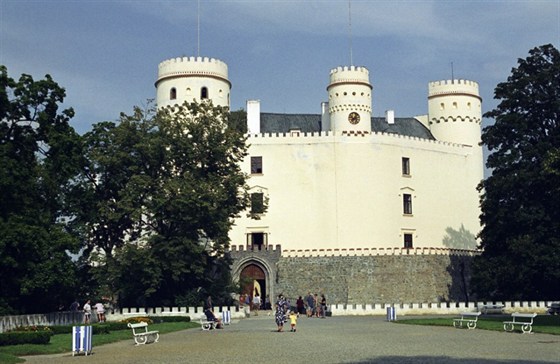


The first written mention of Orlík dates back to 1230 – 1251, from the reign of Wenceslas I, when the archives mention the customs duty on the Vltava River at Orlík, which at that time was only a wooden castle. Reports from 1287 – 1288 prove that Orlík belonged to the royal possessions of King Wenceslas II. At that time, Zdislav of Šternberk is mentioned as a burgrave. In the 13th – 14th centuries, Orlík was rebuilt into a stone Gothic castle, which served as a stronghold and administrative center of royal power. Orlík remained in the hands of the Czech kings until 1357, when Charles IV granted it in a noble manor to his chancellor Dětřich of Portice, but he soon ceded the castle to his nephew, who was the royal burgrave at Vyšehrad.
In 1369, Charles IV donated Orlík to Hyncík Pluh of Rabštejn, who exchanged it with Zikmund Huler for his estates in Cheb.In 1407, Sigismund’s brother Ondřej Orlík sold it to Petr Zmrzlík of Svojšín, who was the highest mint master of the kingdom, but also belonged to Jan Hus’s party. After a devastating fire in 1508, Václav moved to Lnář, and in 1514 he sold the Orlík estate to Kryštof of Vamberk, who was also the owner of Zvíkov. Thus, Orlík became the seat of the economic administration of the Orlicko-Zvíkov estate. In the years 1514 – 1520, Orlík was thoroughly repaired and raised by one floor. In 1611, after the death of Petr Vok, the Orlík Švamberks became the heirs of the extensive Rosenberg property. After the resettlement of Jiří Vamberk, only the manorial administration remained in Orlík. In 1620, after the Battle of White Mountain, Orlík surrendered to the imperial troops. In 1623, Orlík bought Oldřich of Eggenberg from the emperor. The wife of the last childless Eggenberg was Marie Ernestina Schwarzenbergová, who bequeathed the entire Eggenberg property to her nephew Adam František Schwarzenberg, and so the Orlík estate fell into the hands of the Schwarzenbergs. In 1840 – 1860, the neo-Gothic modifications of the building itself, which were carried out according to the plans of the professor of the Prague Academy, Bernard Gruber, culminated. It is still in this form today. Near the chateau there is a large, natural landscape park with an area of 143 ha. In the western part of the park there is a pseudo-Gothic Schwarzenberg tomb.