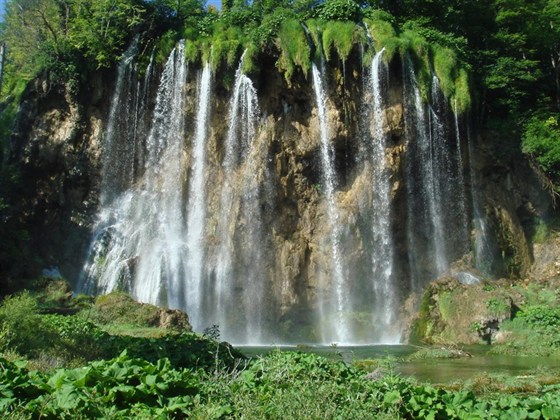


There are two entrances to the lake area (in the lower part of Ulaz 1 – Rastovača, in the middle part of Ulaz 2 – Hladovina), each with a large parking lot (paid) and the possibility of refreshments. Visitors will also receive a map of the lake system with marked sightseeing routes as well as local transport routes in the park by bus and boat (included in the ticket price), so they can orient themselves very well. There are a total of six sightseeing routes in the national park, color-coded, three from each entrance. The choice depends on the time that the visitor wants to devote to the tour.
Opening hours (the park is open every day, on Sundays and holidays):
- Winter period: 9 a.m. – 4 p.m.
- Spring and autumn period: 8 a.m. – 6 p.m.
- Summer period: 7 a.m. – 8 p.m.
Plitvice Lakes National Park is located at an altitude of 500 – 640 m, in the area of Lika. It is a system of 16 lakes, connected by waterfalls and cascades. Area 295 km2 (of which the lake level is 2 km2). National park since 1949, on the UNESCO World Natural Heritage List since 1979. A unique natural phenomenon not only within Croatia.
The lake system is surrounded by the forested hills of the Velika Kapela and Plješevice massifs. The system is divided into two parts: the lower one with 4 lakes (Milanovac, Gavanovac, Kaludjerovac, Novakovića Brod) and the upper one with 12 lakes (Prošćansko Lake, Ciginovac, Okrugljak, Batinovac, Vir, Veliki Jovinovac, Mali Jovinovac, Galovac, Milino Lake, Gradina Lake, Veliki Burget, Kozjak).
It lies in a limestone depression, which was probably formed eight thousand years ago and is constantly changing due to the growth of travertine dams on terraces (depending on the climate, among other things), erosion of travertine blocks and other reasons. The formation of terraces-barriers is mainly due to unique bacteria living in moss and grass on terraces (barriers grow by about 3 cm per year). The lower lakes were formed by the collapse of the ceilings of underground caves and their filling with water.
The Plitvice River, which gave the lake system its name. It does not connect any lakes, but falls by a high waterfall from the side into the canyon below the lowest lake Novakovića Brod. The lake system was therefore not formed in its riverbed, but on the nearby rivers Bijela Rijeka and Crna Rijeka. Only after merging do their waters merge with the Plitvice River. The resulting river is called Korana.
The highest is Lake Prošćansko – 639 m above sea level (it is the second largest in the system, 68 ha), the level of the lowest Novaković Brod is at an altitude of 503 m above sea level. The largest lake Kozjak (81.5 ha) is also the deepest (46 m).
The lakes are connected by waterfalls, the most beautiful of which are Sastavci, 49 m high. The highest waterfall is the one through which the Plitvice River falls from a height of 76 meters into the canyon.
The waters of the lakes have different colors, from emerald green to deep blue. In the lower part of the system there are 20 karst caves. In winter, the lakes freeze, in summer the water temperature is up to 24 °C.
The local forest cover is considered by experts to be one of the best preserved of its kind in Europe. The local flora is also rare. Within the park, there are strictly protected and inaccessible endemic sites (e.g. a meadow with 42 species of orchids and another with 16 species of lilies, etc.), and there are also inaccessible forest reserves. The forests are home to both large carnivores (bears, wolves, lynxes – supposedly the most of all Croatian localities) and an abundance of large and black game. The lakes are rich in fish and crayfish, but hunting is prohibited.
Currently, the entire park is not accessible. The reason for the closure of some parts is the protection and conservation of the ecosystem. It is possible to see the lakes, around which sidewalks are built and are included in the sightseeing routes. Sightseeing and movement along the marked routes are safe.
The lake system was not damaged by the war in the early 1990s (only hotels), on the contrary, nature benefited greatly from the five-year peace and regeneration during and immediately after the war.
From Zagreb it is 140 km to Plitvice Lakes, from Split 219 km (via Knin), from Rijeka 168 km (via Senj).