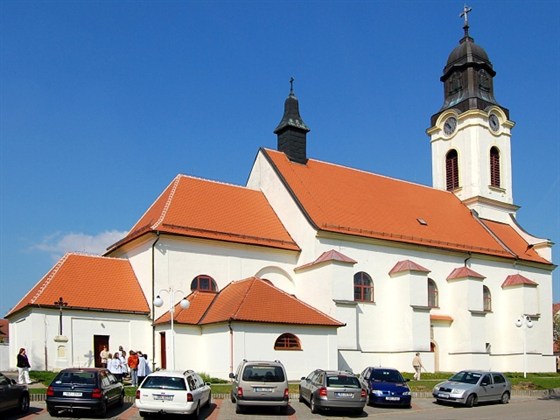


The Church of the Assumption of the Virgin Mary is a purely Baroque building. The first written mention dates back to the 14th and 15th centuries. Originally, the church of St. Catherine stood here. The current church was built in the second half of the 17th century by Count Frederick of Oppersdorf. The church lacked a tower with bells. The old bell tower was then located right next to the rectory.
In the second half of the 19th century, a new project was developed for the construction of a church tower with an adjacent staircase and a side altar of St. Cyril and Methodius was purchased. A total of five bells were purchased for the tower, which were requisitioned during the First World War. New bells were purchased in 1927 and in that year electricity was introduced into the church. In 1921, an organ was purchased for the church. After the Second World War, the bells were connected to electricity. The tower was fitted with dials and a clockwork was purchased. In the second half of the 20th century, minor reconstructions of the church were carried out, such as the repair of the façade and the doubling of the windows. In 1993 and 1994, a general repair of the tower and façade was carried out.
The altar painting of the Assumption of the Virgin Mary is a copy of the painting by the famous Italian master Domenicheni. From the second half of the 18th century there is a pulpit, a baptistery and two side altars of St. Barbara and St. Wenceslas, as well as statues of Pietà and St. John of Nepomuk in front of the church. A sanitary facility was created from the original sacristy. The value of this extension was about CZK 1,500,000 and was financed from donations from believers.
In 2009 and 2010, a general repair of the church roof was carried out in two stages, which included the repair of the wooden structures of the truss, the replacement of the roof covering and minor masonry and plumbing work. The total cost of the repair was about CZK 3 million. The repair was financed mainly from donations from the faithful and part of the costs was covered by subsidies from the Ministry of Culture, the South Moravian Region and the contribution of the city of Velké Pavlovice.