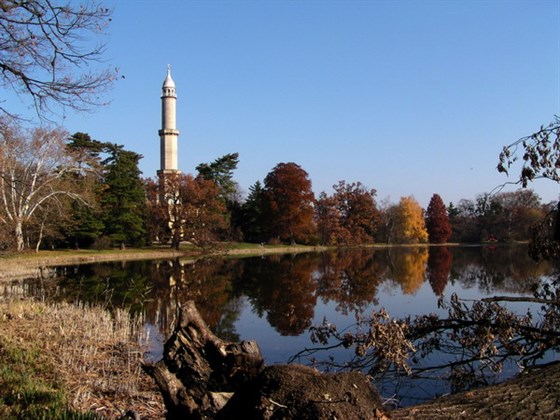


The Minaret lookout tower is located in the Lednice park about 2 km north of the castle. There are two paths leading around the Castle Pond, one of which contains the remains of the Aqueduct. Tourist boats go here on the Dyje River, and horse-drawn carriages on dusty roads.
A minaret in the land of Christians! No wonder it aroused curiosity and stimulated people’s imagination. There is a legend among the locals according to which the great patron of the arts , Alois Joseph I, originally wanted to build a church here. But somehow he and his subjects disagreed on the place of construction, they quarreled – and the result is a mischievous princely revenge: an Islamic symbol. Some claim that the entire mosque was supposed to stand here, which we did not see only thanks to the quicksand.
There is probably not much truth in the legend; however, there were also Turkish baths , a Swiss bridge and Chinese palaces in the area. The idea to make the lookout tower “Islamic” may have come from the architect Josef Hardmuth himself, the author of a modern pencil, for whom the minaret resembled a life-long invention.
The costs were borne by Hardmuth, many wooden piles and beams were needed to strengthen the subsoil, many people worked on the work (apparently including Arab artists) and due to the shape of the minaret, it was necessary to build a special spiral scaffolding. The workers were afraid of this unusual structure and refused to step on it. Their fears were allegedly dispelled by an imperial corporal of a cavalry regiment, who rode on horseback to the top without a single part of the scaffolding moving.
The minaret is almost 60 m long and 302 steps lead to its upper gallery. From above, you can see the park, Pálava, the White Carpathians and even the top of the tower of St. Stephen’s Cathedral in Vienna. The eight halls on the first floor, which are not open to the public, were once a “warehouse” for oriental objects that the Liechtensteins brought from their distant travels. The floors and walls of the space are decorated with Moorish drawings and inscriptions.