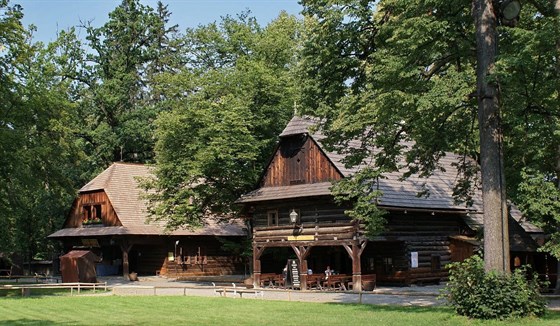


Rožnov pod Radhoštěm was founded in the middle of the 13th century, between 1246 and 1267, by the Bishop of Olomouc, Bruno of Schaumburk. It is from 1267 that the first mention of the town exists. Bruno of Schaumburk listed the town in the list of his property before leaving for the crusade. The founding of the town in that year is documented in the last will of this bishop dated November 28, 1267, in which there is the following section: “On the third side (due to the borders of the Hukvalský estate bought by him) Rožnov and Hrachovec (Rosenowe et Grabowe), which are among the old circles of our church, but settlements founded by us”. The town was founded during Bruno’s colonization efforts literally “on a green field” and was originally entirely wooden. The houses on the square stood in straight rows, the arcades rested on columns with a gallery. Over the years, several aristocratic families changed in Rožnov. In 1548, the Žerotín family acquired the manor and kept it until the 19th century. During their reign, the economy and crafts flourished in Rožnov. Glass crafts and weaving became important in the town. Rožnov was known for weaving linen and muslin throughout the Austrian monarchy. As early as 1687, a paper mill was established in Rožnov and from 1712 also a brewery. Wallachian embroidery achieved fame.
However, it is possible that settlers lived in the territory of today’s Rožnov before 1267 and the bishop only expanded or legally organized the settlement. But on the map from the 13th century, Rožnov is not yet marked; it was only a smaller settlement. Bruno considered this corner of Moravia to be very important, because it made an easy transition to Hungary, whose king Béla lived in enmity with Přemysl Otakar II. At that time, Rožnov was the last settlement on this side on the Moravian-Hungarian border and therefore the guardian of the crossing.
Not far from the settlement on the southwest side, a cone-shaped hill of volcanic origin named Hradisko rose above the Bečva River and a castle of the same name was built on it.
It is not known whether the castle on the hill of Hradisko was built by Bishop Bruno or by his successor in the property, but as early as 1310 the castle above Rožnov stood and was called there.
Middle Ages
And it is the ruins of the Gothic castle that remind us of the medieval history of the town. Originally a guard castle, it stood on the Hradisko hill above the town from the 13th century. It gradually grew and, together with the castles of Helfštýn and Hukvaldy, served to protect Moravia from Hungarian invaders. Over the years, the aristocratic family of the Lords of Kravaře, Cimburková or the Transylvanian Duke Peter took turns here. The castle seat above the town was also seized by the robber knight Jan of Messenberg. The castle was destroyed in the 15th century – by order of Emperor Ferdinand I, it was partially demolished in 1539, when bandits settled in it.
In recent years, archaeological research has led to the discovery of unique Gothic tiles in the castle ruins.
At the beginning of the nineteenth century, Rožnov still had mostly wooden houses, only four low brick houses stood on the square. The first larger one-storey house was built only in 1839. Only slowly did the wooden town change into a stone one. The inhabitants mainly made a living from low-yield agriculture and shepherding. According to the shepherds – Wallachians, the settlers were called Wallachians and the whole area of Wallachia. Radhošť and Pustevny are still associated with sheepfolds, shepherds and numerous flocks of sheep. In the middle of the last century, up to 15 thousand of them grazed on the ridges of the Beskydy Mountains. A shepherd took care of them, from their milk he produced sheep cheese bryndza and whey called žinčica.
Spa
In 1796, the local favorable climatic conditions were noticed by the Brno physician dr. Kročák and sent the first four patients with breast disease here. A surprisingly good result and an increasing number of guests gave rise to the creation of a climatic spa. It was founded in 1820 by the then director of the local estate, Josef Drobník. Initially, it was treated with žinčica and field walks, later also with baths and electrotherapy. The climatic spa reached its greatest prosperity at the beginning of the 20th century, when up to 3000 guests from almost all over the world came to Rožnov during the summer season. The world-famous doctor, founder of psychoanalysis, Sigmund Freud, and the founder of genetics, Georg Mendel, also walked along the spa colonnade in the Rožnov park. The spa was used to treat diseases of the respiratory system, lungs and also the heart.
The end of the spa history was made by the Second World War. However, the healthy climate, the beauty of the surrounding landscape and the friendly city remained, so the spa history is now remembered perhaps only by the spa house in the city park.
After 1945
The town experienced the greatest boom after World War II, when the Tesla industrial company was built there. The number of inhabitants of Rožnov has quadrupled to the present day and is approaching twenty thousand.
Rožnov pod Radhoštěm is characterized by the original buildings on the left bank of the Bečva River, as well as the typical architecture of the past decades with prefabricated houses and an extensive industrial sphere in the northwestern part. A semicircle around the historic center of the town is a city park. In the past, paths with seats were adapted for spa guests. Even today, it has many charms – a lake or a linden alley, planted at the beginning of this century. In the center of the city park stands a former spa house, today a tastefully restored building, the seat of the First Wallachian Inn Brewery.
One of the memorable buildings in the town is the Catholic church, dedicated to All Saints, built in 1748-52. It is worth noting the building of the current seat of the Beskydy Protected Landscape Area, a historical building, built 200 years ago, originally the first school in Rožnov, then a rectory and later a bakery. Even today, Rožnov pod Radhoštěm is changing its face. The burgher houses on the square are reconstructed. A new shopping center Na zahradách is being built. A newly stylized villa district of Stráň is being built.
Industry
From industry, weaving was especially widespread in the Rožnov region. As early as 1687, a paper mill was established in Rožnov and from 1712 also a brewery. Wallachian embroidery achieved fame. Traditional products included split shingles, juniper pipes and other wood products. Glassworks used to stand in the surrounding villages. The industry is currently represented by more than a hundred companies located in the industrial area of the former Tesla company. The tradition of knitting is maintained today by the LOANA company, and the paper industry has been preserved. Even with the existence of a prosperous industry and a successfully developing small business, the town maintains its traditional character. Rožnov pod Radhoštěm is an important cultural and especially tourist center.
Thanks to its location, protected by the surrounding hills from the north, the town is still characterized by a favourable climate. The subdued Carpathian winds that flow into the Rožnov basin disperse the fogs and keep the weather sunny in Rožnov for most of the year.