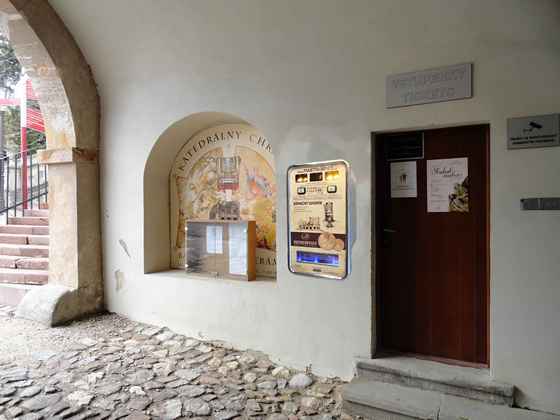


Nitra Castle is one of the oldest preserved buildings in the Nitra Region. According to archaeological excavations, the first beginnings of construction activity on the castle hill can be traced back to Roman times, when there was a Celtic, Dacian and later Germanic settlement in the castle. The first written mention of a fortified fortified settlement on the site of today’s castle dates back to 871. It mentions the construction activities of Prince Pribina and the consecration of his church in Nitra around 830. After the incorporation of the Principality of Nitra into the Moravian estate, the Nitra fortified settlement remained an important settlement center. In the period of Great Moravia, Prince Svatopluk stayed in Nitra and in the years 880 – 892 there was also a bishop’s residence here. After the fall of Great Moravia , this bishopric ceased to exist, but after the establishment of the Hungarian state , it was restored in the second half of the 11th century . The importance of Nitra Castle at this time is confirmed by the so-called . Maurus legend from 1064 – 1070 , which mentions the Basilica of St. . Emeram , in which the remains of St. . Andrew and Benedict . Andrew and Benedict . After the establishment of Hungary , Nitra Castle remained the seat of the allotment principalities , ruled by the successor to the Hungarian throne . During this period , the original Wall Wall was transformed into stone walls . As a strong and stone castle , Nitra resisted the Tatar invasion in 1241 , but three decades later in 1271 , however, it was badly damaged by fire during the siege by Přemysl Otakar II . After the fire , they restored not only the church , but probably also the fortifications of the castle . At the beginning of the 14th century , it was conquered twice in a row by Matúš Čák , and in 1431 it was besieged by the Hussites . Under King Sigismund , a new castle fortification was built in the first half of the 15th century , but even of this , little has been preserved , because in 1465 the castle was again ravaged by the army of King Matthias Corvinus . Further fortification buildings at the castle came in the 16th century , at the time of the Turkish danger , when they built a Renaissance castle palace and a new inner castle gate . During the uprisings of the estates in the first half of the 17th century , the castle was the center of military operations and in 1663 it even fell into the hands of the Turks for a short time . After removing the damage , they rebuilt the entire defensive system of the castle in the years 1673 – 1674 according to the requirements of modern fortification . However, great construction and restoration activities took place at the castle only after the end of the uprising of František Rákóczi at the beginning of the 18th century, when they rebuilt the so-called . upper church and built a new Bishop’s Palace . Constant reconstructions of the castle almost completely erased its original appearance . From the oldest development stage , a part of the Great Moravian palisade is uncovered , which can be seen in open casemates . Only a part of the Church of St. . Emeram from the first half of the 13th century has been preserved . From the Gothic period , a part of the fortification wall and a large Gothic (so-called upper) church from the first half of the 14th century have remained. From the 16th century the inner castle gate has been preserved. Only buildings from the end of the 17th and 18th centuries have been preserved in relatively good condition. The castle courtyard, casemates with a Great Moravian rampart, Vasil Tower, St. Emerama Cathedral are open to the public. Emeram and the Diocesan Museum.
Back to map
Commemorative coins
Nitra Castle
Location photos
Explore the location