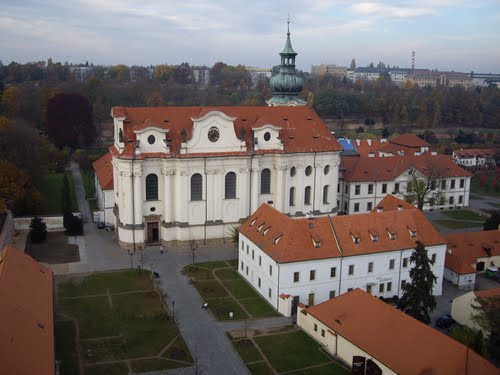


The Břevnov Monastery is a monastery of the Benedictine order. The Benedictines follow the Rule, or a kind of constitution written for them in the 6th century by St. Benedict of Nursia, Italy. The life of this order is best described by the traditional Benedictine motto pray and work.
The monastery was founded in 993 by the Prague bishop St. Adalbert († 997) and Prince Boleslav II. Pious († 999). It was the first male monastery in the Czech territory at all. In the 11th century, the first stone church was built in Břevnov under Abbot Menhard. Its crypt has been preserved under today’s basilica to this day. Later, a more spacious Gothic church was built on the same site where the older Romanesque church stood. The Břevnov monastery suffered great damage during the Hussite wars.
It underwent restoration and Baroque reconstruction after the Thirty Years’ War under Abbot Tomáš Sartorius († 1700) and then, especially in the first half of the 18th century, under Abbot Otmar Zink († 1738). He hired leading builders and artists of the time, such as Kryštof and Kilián Ignác Dientzenhofer, Petr Brandl, Karel Josef Hiernle and others. Their work then created an artistically valuable and still admired complex of buildings with a garden. An ambitious plan to establish an aristocratic academy in the rebuilt Břevnov in the 18th century failed.
The history of the monastery in the twentieth century was turbulent. In 1950, the Břevnov monastery, like other monasteries, was taken over by the communist government. Abbot Anastáz Opasek († 1999) was unjustly accused and spent the 1950s in prisons. The monastery fell into disrepair during the communist era. The restored Benedictine community, with the help of the state and foreign monasteries, managed to repair the monastery buildings and celebrate the 1000th anniversary of the monastery in 1993 with dignity — the Břevnov Abbey was awarded the honorary title of “Archabbey” by the Pope on that occasion. In 1997, Pope John Paul II also personally visited the Břevnov monks during his visit to the Czech Republic. In 1999, after the death of Anastáz Opasek, Prokop Siostrzonek became the head of the monastery as prior-administrator. In recent years, repairs to the entire complex have continued and the life of the monastery has grown into the life of Prague’s Břevnov at the beginning of the 21st century.