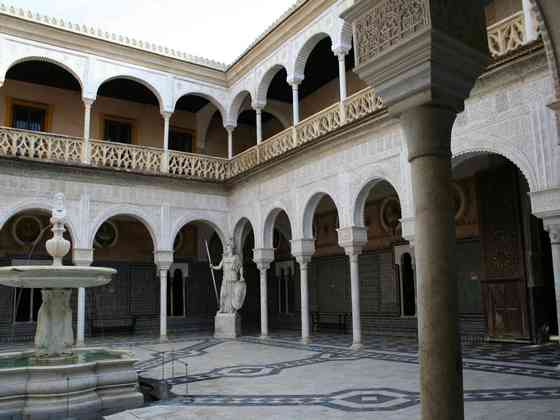


Seville is the cultural center of the south of Spain, it lies on the Guadalquivir River and is the capital of the province of the same name and the whole of Andalusia. With more than 700 thousand inhabitants, it is the 4th largest city in Spain (after Madrid, Barcelona and Valencia). Interestingly, Mudejar architecture has been popular for many periods, let us recall, for example, the Casa de Pilatos, one of the most beautiful buildings in Seville. The city walls with entrance gates offer you an excellent vision of the city through the past.
Major sights:
Seville Cathedral:
It is the 3rd largest cathedral in Europe (after St. Peter’s Basilica in the Vatican and St. Paul’s Cathedral in London). The construction of the cathedral began in 1402 and continued until the 16th century. It stands on the site of the original mosque, of which only the minaret – the Giralda – remains.
It also houses a sarcophagus with the remains of Columbus, carried by life-size statues of the four kings. However, the authenticity of the relics is often questioned, as the great navigator is also said to be buried in Santo Domingo.
Alcázar:
The Royal Palace, originally a Moorish fortress, but most of the modern Alcázar was built on the ruins of a Moorish palace by Pedro I of Castile (also known as Peter I the Cruel), who had it built by Moorish builders, which is why the Alcázar has an Islamic appearance. Charles V then had some Gothic elements added to contrast with the Mudejar style
Other places of interest in Seville include:
Archaeological Museum
Museum of Art
María Luisa Park
Church of Santa Cruz
Triana
Alameda Promenade
Church of St. Salvator
Church of St. George
Hospital de la Caridad – from the 17th century
Church of Santa Catalina – built in the 14th century
Town Hall – from the 16th century, built in the Renaissance style
Church of San Luis – a Baroque church completed in 1730
Macarena basilica – a modern church built between 1936 and 1941 by the architect Gómez Millán in the neo-Baroque style.