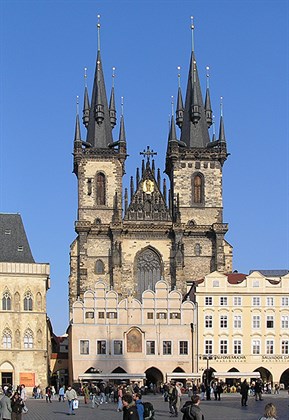
Church of Our Lady before Týn – the original Romanesque church, mentioned for the first time in 1135, belonged to the merchants’ hospital and got its name from the fenced place, the Týn Court, which was also called Ungeld. The construction of the church in its present form began in the middle of the 14th century. It was not until 1457 that the truss above the main nave was made and in the following years, during the reign of King George of Poděbrady, the construction of the western gable took place. In it, a statue of the king was erected with the inscription Veritas vincit – Truth wins and above it a large golden chalice, which could hold four measures of grain. The chalice allegedly came from the first Christian times, but it was said that it was even older. Although Catholic priests paid thieves well to steal the chalice several times, no one succeeded. The precious chalice caught the eye of storks, who set up a nest in it and brought a large number of earthworms, snakes and frogs into it. These vermin then fell down to the square and the snakes spread out into the streets. The Hussites would have liked to take down the chalice, but they could not do it because of their faith and also because of the ridicule of the Catholics. A solution was found when the storks flew to warm lands, the Hussites covered the chalice with a large plaque. In the Hussite period, the church served as the main temple. Jan Hus’s predecessors, Konrád Waldhauser and Jan Milíč of Kroměříž, had already preached in the Týn Church. From 1427, the elected Hussite archbishop Jan Rokycana, who is also buried in the church, preached here. The church served the Ulysses until 1623, when it was taken over by the Jesuits and in 1626 they replaced the statue of the king with the figure of the Madonna and made a halo from the chalice.
Of the entrance portals, the northern portal is undoubtedly the most beautiful, the work of the parléř glassworks, created from the 80s of the 14th century until its end. It is decorated with canopies, which were supposed to protect the sculptural decoration. Slabs with relief sculptural decoration, which are among the top works of our medieval sculpture, were inserted into the tympanum. There are depicted Passion scenes – the Flagellation, the Crowning with Thorns and the Crucifixion. The Master of the bust of St. Cyril from the upper triforium in the Cathedral of St. Vitus or an artist from his circle is usually referred to as the author. In the interior of the church there are a total of 19 altars, richly carved and sculpturally decorated, mostly early Baroque. The main altar with a depiction of the Assumption of the Virgin Mary is one of the most elaborate in the entire Czech Republic. In 2000, a rarely preserved fresco of St. Jerome was discovered in the northern aisle. Jerome with a lion from the end of the 14th century. Among the interesting personalities, the astronomer and astronomer Tycho Brahe , who has a beautiful stone tombstone here, is buried in the church.
The pair of characteristic towers of the church are unequal – one of them is more ornate and wider, and it is said that it represents the stronger part of the family, i.e. the man. In 1992, the bell tower of the north tower was equipped with a bronze bell weighing 960 kg, which replaced the historic bell, taken away during the German occupation during World War II. The Týn Church has been a national cultural monument since 1962.