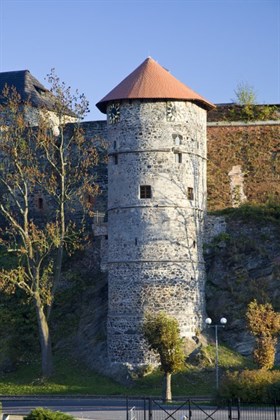


The long history of Cheb Castle began at the beginning of the 12th century. Its history is connected, among other things, with the powerful Staufen family, from which a number of Roman-German kings and emperors emerged. It was one of them, the famous Friedrich Barbarossa, who had the original building rebuilt into an imperial palatine at the end of the 12th century, the only representative of this type of castle architecture in our territory. To this day, the torso of the once magnificent palace, the mighty defensive Black Tower and, above all, the unique double Romanesque-Gothic chapel of St. Martin, Erhard and Ursula have been preserved.
Friedrich Barbarossa visited the castle repeatedly in person, held imperial assemblies here and even stayed here shortly before leaving for the Third Crusade, during which he met an unexpected death in the rapid flow of the Salef River. However, Friedrich was not the only ruling head who was hosted by the cozy chambers of Cheb Castle. He was also visited by the “Father of the Fatherland” Charles IV and the Hussite King George of Poděbrady. The castle also experienced difficult and turbulent times, a number of wars and conquests. Hussite chariots rattled around it, during the Thirty Years’ War mercenaries in Swedish service ravaged with weapons, and in the 40s of the 18th century, it was plundered with fire and sword by the troops of the French king Louis XV, who fought with the only woman on the Czech throne, the indomitable Maria Theresa. Every good castle has its own ghost, and it is no different at Cheb Castle, where the last faithful companions of Albrecht of Wallenstein, who fell victim to the murderous rampage in the early evening of February 25, 1634, have been struggling for several centuries. The castle underwent its last development phase at the turn of the 17th and 18th centuries, when it was partially rebuilt into a Baroque fortress citadel.