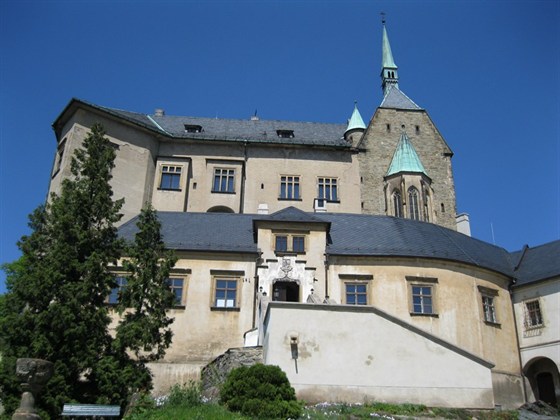


Šternberk Castle, originally a defensive medieval residence with a preserved cylindrical tower and the remains of the fortifications of the main palace, attracts visitors with its unusual atmosphere. The charming backdrop of the castle is then formed by the surrounding forest park and today’s castle grounds.
Šternberk Castle was founded in the middle of the 13th century by Zdeslav of Chlumec and of Šternberk, a member of an old Czech aristocratic family. The first written record can be found in a document from 1269. The document also defined the boundaries of the Šternberk estate and the Hradisko monastery. From a defensive seat, the castle was rebuilt and expanded in the 70s of the 14th century . Bishop Albert II of Sternberg, an important church dignitary and influential diplomat, used the castle as his residence. The bishop’s attention was focused mainly on the chapel, which he had decorated in the style prevailing at the court of Charles IV at the time. During the tour, you will be surprised by the ruggedness of the castle and its large area and rich decoration from Gothic to Art Nouveau.
In the 16th century, thanks to the Berka family of Dubá and Lipá, the Renaissance reconstruction of the castle took place. After a large fire, the castle was expanded by reconstruction with a Renaissance wing with a “Business Card Hall” and unique edge vaults. The Berks also intervened in life in the castle grounds, in which they had a system of farm and administrative buildings built.
The history of Šternberk Castle is directly connected with the Šternberk family and with the turbulent moments of Czech history – with the Hussite wars, with the descendants of the Czech king George of Poděbrady, with the princes of Münstrberk and with the Thirty Years’ War, during which the town and the castle suffered considerably. Around 1699 , the seat was bought by Prince Jan Adam Ondřej of Liechtenstein. The castle remained in the possession of his family until 1945. The castle was not used for a long time and fell into disrepair. It was not until 1886 that it was decided to reconstruct it in general according to the project of the Viennese architect Karl Gandolph Kayser in the spirit of Romantic historicism. A luxurious residence was created that met the requirements of the modern aristocrat John II, who gradually equipped his residence with historical furniture, paintings, furniture, sculptures, tapestries.