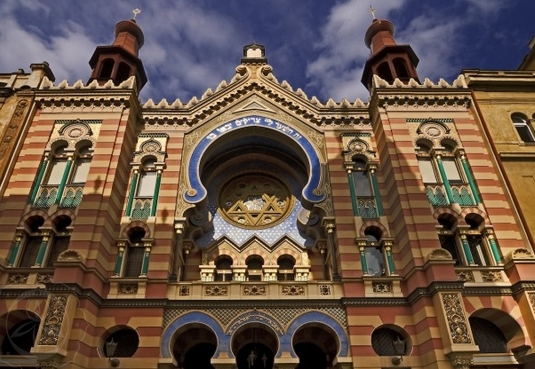

The youngest, but the largest synagogue building in Prague was built by the architect W. Stiassny in 1905 – 1906 in the pseudo-Moorish style. It is a replacement for the Gypsy, Great Court and New Synagogues, which were demolished during the redevelopment of the Jewish Town. . The façade of the building is characterized by a massive arch with a large rosette window, in which there is a six-pointed Star of David. The center of the western façade is decorated with a Czech and Hebrew inscription: ? This is the gate of the Lord, through which the righteous enter. Don’t we all have one father? Didn’t one God create us? There are two towers on both sides of the entrance. The original name for the Jerusalem Synagogue was the Jubilee Synagogue and referred to the fiftieth anniversary of Franz Joseph’s accession to the throne. For the Jews, these 50 years meant a period of relative peace and prosperity, which is why there were many buildings that bore this designation. After all, it got its name from the place where it stands – from Jerusalem Street. The fact is also somewhat paradoxical, because the street is named after the Christian chapel that stood in the cemetery at St. Henry. Henry sometime in the 14th century, in honor of soldiers who went to fight in Palestine.
The façade of the building is characterized by a massive arch and a large rose window, where the six-pointed Star of David is located. The center of the west façade is decorated with a Czech and Hebrew inscription: “This is the gate of the Lord, through it the righteous enter. Don’t we all have one father? Didn’t one God create us?” There are two towers on both sides of the entrance. The synagogue has 850 seats, the side galleries with separate entrances are intended for women. The inner front of the temple is decorated with a vine motif. Above them are the tablets of Moses with the Ten Laws. After the first major reconstruction in the 1990s, the synagogue was ceremoniously reopened in 1996. Under the layers of plaster and a layer of old painting, richly painted ornaments in the Viennese Art Nouveau style were discovered, which no other Jewish temple in the world can boast of. The Jubilee Synagogue, like the Staronova Synagogue, is still used for religious services.