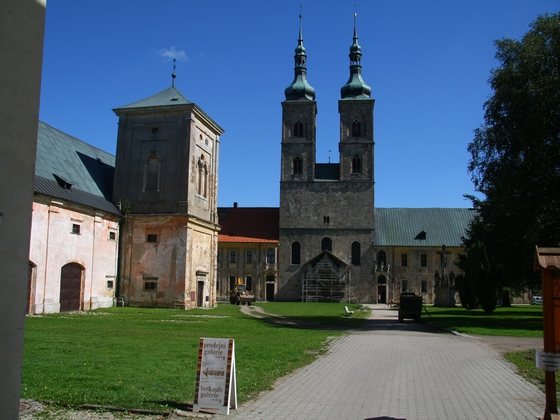


On the Teplá River, in the Teplá Highlands in western Bohemia, there is a town and monastery of Teplá near Mariánské Lázně. Already at the beginning of the 12th century, there was probably a Slavic fortified settlement in this place, and from 1385 the settlement of Teplá was granted town rights.
However, Teplá is famous mainly for its Premonstratensian monastery, which was founded here in 1193 by the Czech nobleman Hroznata, who immediately called the Premonstratensian monks from Prague’s Strahov to it.
However, Teplá is famous mainly for its Premonstratensian monastery, which was founded here in 1193 by the Czech nobleman Hroznata, who immediately called the Premonstratensian monks from Prague’s Strahov to it.
The Teplá Monastery is, although it does not seem so at first glance, one of the gems of our church architecture. Although it looks shabby from the outside, it hides, among other things, a huge library and you will probably be thrilled to visit it.
The Premonstratensian monastery in Teplá is located on the river of the same name, near Mariánské Lázně in the Karlovy Vary Region. According to the monastery legend, the monastery was founded in 1193 by the magnate Hroznata and he called the Premonstratensian monks from Prague’s Strahov to it. He founded the monastery in exchange for not having to participate in the Third Crusade. At the end of the century, Hroznata himself joined the ranks of the friars and became the administrator of the monastery property. This became fatal for him, because on one of his inspection trips he was captured by robbers who demanded a ransom for his release. Although it was paid, Hroznata was killed in 1217. Since then, he has been worshipped as a martyr, he was beatified on September 16, 1897. In 1232, the church monastery was consecrated by the Bishop of Prague, and the celebration was also attended by the Czech King Wenceslas I. The Teplá colony then experienced a period of prosperity and times when it stood on the very verge of extinction.
The monastery was affected by the plague epidemic several times, had to face the attack of the surrounding nobles, but on the other hand, it avoided the Hussite storms. Further difficult times were marked by the arrival of the Reformation and also the Thirty Years’ War. After the second Prague defenestration, Chancellor Slavata found temporary refuge in Teplá, so the troops of Frederick the Palatinate significantly damaged the monastery. In 1641 and 1648, the monastery was plundered by the Swedes. In 1659, the buildings of the convent and the prelature were affected by a devastating fire.
Nevertheless, the monastery in Teplá rose from the ashes, buildings were repaired and new ones were built in the area. Their Baroque appearance was due to the builder K. Dientzenhofer, who did so at the request of Abbot Raimund II. Wilfert (1688 – 1722). Further flourishing of the monastery was associated with the local healing springs. A great merit in their fame was due to Abbot Kryštof Heřman, Count Trauttmannsdorf-Weinsberg, during whom the Teplá monastery became a center of art and science, a school and an aristocratic convent were founded. The monastery in Teplá was at the origin of Mariánské Lázně, which belonged to the monastery.
During World War II, the canonry was misused for the needs of Germany. In one part there was a prisoner of war camp, in another a maternity hospital for volunteer mothers for Hitler’s army was established. After the war, members of the order who were of German nationality were expelled and in 1950 some of the brothers were imprisoned and the monastery complex was used by the Czechoslovak army. army as a barracks. After the social changes in 1989, the monastery was returned to the Premonstratensians and already in December Abbot Heřman Josef Tyl celebrated the first mass. Now the Teplá canonry has 18 members and administers parishes in many places in western Bohemia. The monastery is open to the public.
During World War II, the canonry was misused for the needs of Germany. In one part there was a prisoner of war camp, in another a maternity hospital for volunteer mothers for Hitler’s army was established. After the war, members of the order who were of German nationality were expelled and in 1950 some of the brothers were imprisoned and the monastery complex was used by the Czechoslovak army. army as a barracks. After the social changes in 1989, the monastery was returned to the Premonstratensians and already in December Abbot Heřman Josef Tyl celebrated the first mass. Now the Teplá canonry has 18 members and administers parishes in many places in western Bohemia. The monastery is open to the public.
The monastery complex today consists of a Baroque convent, a Gothic presbytery of the monastery church with a Romanesque chapel, a monastery library, a park, a cemetery and a museum. The most important building is the Church of the Annunciation of the Virgin Mary, it was built in the years 1193-1232 as a Romanesque-Gothic three-nave church. You can also see the farm buildings of the brewery, hayloft, and granary.