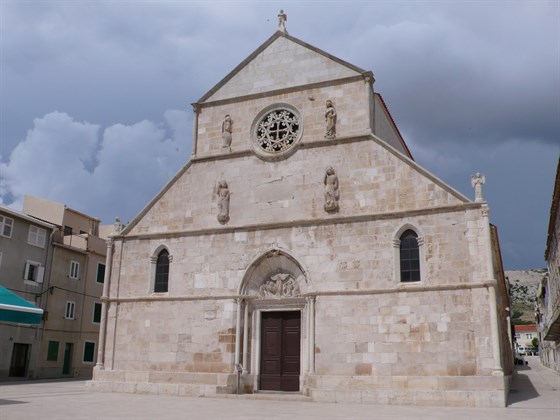


When the sarcophagus arrived in the town in 800, there is a St. Jury in front of the church, which was on the site of today’s church. However, the inhabitants of Rovinj demanded a larger church that would be worthy of a sarcophagus with the body of St. Euphemia, and in 950 a new church was built. It was a three-nave basilica with three semicircular apses. In the center of the church was the sarcophagus and since then the patrons of the city of Rovinj, St. George and St. Euphemia. After several centuries of constant expenses and restoration, the need for a new church reappeared. The current church of St. Euphemia and St. George.
On December 8, 1720, it was decided to build a new large church, but the first concrete steps were taken a little later. In 1724, the Committee for the Construction of the Church entrusted the Venetian architect Giovanni Scalfarotta (1690-1764), who was one of the most important architects of the first half of the eighteenth century. Scalfarotto had already begun the construction of the church of S. Simeone of Giuda in Venice. one of the most important buildings of Classicism of the eighteenth century. The design church for Rovinj proposed a solution that Rovinj did not accept. The church did not have three naves (what the people of Rovinj wanted), because its size had to destroy the church of St. Joseph. Joseph was supposed to cancel the newly built abscess that should fit into the project. Scalfarotto was the main entrance façade facing the island of St. Catherine, which further angered the inhabitants of Rovinj, who demanded a three-nave structure in which the recently completed apse would be gathered and the surrounding buildings would not be destroyed. Scalfarotto, in spite of everything, persistently demanded said demolition and construction according to his design, so that the board of directors for the construction of the church on April 13, 1724 exempted him from any obligation to pay him 80 ducats.
They also invited the architect Giovannio Dozzio from Venice and commissioned him with a project that would satisfy the wishes and requirements of the client – a citizen of Rovinj. Dozzi was not such a strong personality and famous architect as Scalfarotto was, and she incorporated all the requirements of her client into the project and finally the construction could begin. The foundation stone of today’s church was founded on May 8, 1725, May 16, 1728. all three apses are consecrated in 1734. The side nave was consecrated, and finally in 1736. two more naves or the entire church. Since then, the Church of St. Euphemia has dominated the city and the seascape of Rovinj.
It is also interesting that the church was built on an island, because it was only in 1763 that a narrow narrow channel separating the island from the mainland; before the sowing of the island and the mainland, they were connected by a mobile bridge. We do not know exactly how many inhabitants Rovinj had during the construction of the church, but we do know that in 1750 it had 8782 inhabitants, so one such building really needed.