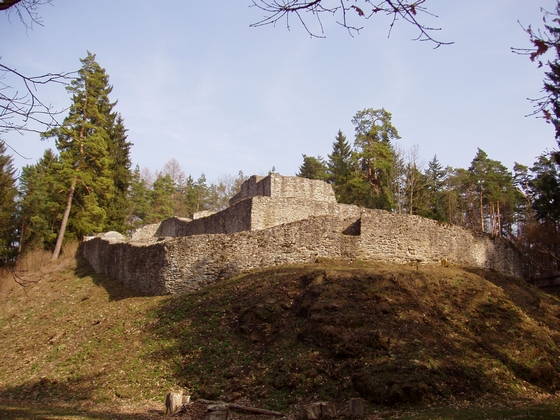


Kozí hrádek is the most memorable castle in the Tábor region. It is not known from the preserved sources when it was built. The oldest reports date back to 1377, when its owner was Vlček of Kozí. Later, Kozí hrádek was the property of the lords of Hardek and Jindřich of Hradec. In 1406 it was acquired by Vilém of Újezd, but he died 2 years later, so it became the property of his sons Ctibor and Jan. Kozí hrádek gained its greatest importance due to the stay of Master Jan Hus, the greatest personality of the Czech reform movement.
In November 1412, a curse was imposed on Jan Hus and he had to leave Prague. He was most likely hiding in the Žatec region. All speculations about his stay in this year are not accurately recorded in any sources. It is most likely that he chose a remote castle near Prague rather than a city. Because an interdict would be imposed on the place where he would be hiding (a ban on all services, funerals, baptisms). Hus kept his temporary residence secret so as not to put his host in danger of being cursed.
At the beginning of the summer of 1413, at the invitation of Jan of Ústí, Master Jan Hus took refuge here at Kozí hrádek. He came to a region that already had its revolutionary traditions, so he did not devote himself only to scientific activities, as he originally intended (he wanted to work on his works), but also to preach. He completed his important Postila here and wrote some other basic works, such as the treatise “On the Sacrilege”, “On the Church” or the treatise “On the Six Delusions”. As Hus said, the people asked for and needed him, so he returned to the task of a preacher. He renewed his sermons from the Bethlehem Chapel. His sermons “under the linden tree” are well-known. The excellent fearless preacher came here to listen not only to the inhabitants of the nearby town of Ústí, but also from far away. In the spring of 1414, Hus visited Prague, but soon returned to our region. No longer to Kozí hrádek, but to Sezimovo Ústí. On July 15, 1414, he left it. There are several versions of his departure. Some claim that the cause was the death of Jan of Ústí (Jan Hus’s host), others are of the opinion that the cause was a strong wave of plague that came here from the Mladovožicko and Chýnov regions. It is certain that Hus left here for Krakovec Castle near Rakovník. From there, he then made his last journey to Constance, where he was burned at the stake for his opinions.
In 1438, Kozí hrádek was destroyed by fire. Experts differ in their opinions. It seems most likely that it was robbed and burned by the mercenary army of Albrecht of Austria, who at that time was besieging Tábor and was located near nearby Měšice. Albrecht of Austria was probably attracted by easy prey. Kozí hrádek was not built in a very safe place. There is no high rock or wide river on either side, which would multiply the number of defenders. The castle could still defend itself against robber bands or against a more aggressive neighbor, but hardly against a huge superiority. After the Hussite wars, Kozí hrádek belonged to the town of Tábor, but the records mention “Goat Castle desolate”. It was on the best way to merge slowly and without a trace with the surrounding landscape, like dozens of similar castles and fortresses. In the 16th and l7. centuries, material from the fortification masonry was used for small construction works in Měšice. It was not until 1886, at the request of the professor of the Tábor grammar school, August Sedláček (the author of Castles and Chateaux), that excavations were dug in the ruins and the rest of the residential tower was uncovered, on which a simple tin plate was later attached, providing visitors with general information. 7 years later, in 1893, the Tábor academic association Štítný wanted to build a memorial at Kozí hrádek. The Austrian authorities were afraid of reviving Hus’s traditions and therefore officially forbade the construction of the memorial. The money had already been collected and so it was used to modify the castle. These modifications were carried out unprofessionally, without a plan, and more archaeological finds were destroyed than saved.
The most important turn for the better was in 1899, when Josef Švehla (head teacher in Sezimovo Ústí) took over the work. Archaeology was his hobby. Thanks to his enthusiasm and 15 years of tireless work, we can now get an idea of the temporary residence of Master Jan Hus. All exhibits collected during the excavations by Josef Švehla (more than 250 exhibits – various primitive children’s toys, a container with contemporary coins, spears, ceramics) are located in the Tábor Museum. On March 30, 1962, Kozí hrádek was declared a national cultural monument and since 1991 it has been owned by the Town of Sezimovo Ústí.
The Goat Castle was built on a narrow promontory of irregular oval shape near the Jezero pond. It was the most suitable place for the building, as the promontory was the narrowest here. A moat was dug around it, which reached a width of up to 20 m to the bailey. It led to the entrance tower, which led to the entrance to the first courtyard. In the first courtyard on the left, you can see two rooms, a smaller kitchen and a larger guardhouse. Part of it was covered by a shelter. On the left there is a well, carved in the rock – 18.5 m deep. Behind the well there is a staircase leading to the cellar. Through a gate in the inner wall, you entered the second courtyard, where there was a rectangular stone residential tower, probably with two floors. It was the dwelling of all the lords who lived here and their officials. A narrow street separated from the tower by a farm building with two rooms, the smaller of which was a granary. Around the first inner wall there was a fence in the south, west and north with an extended gallery on the circular wall. In this circular wall there was a small gate to the moat in the west. The fortifications of the castle were complemented by an earthen rampart above the moat and massive wooden palisades located approximately in the place where the wooden fence is now located. In case you go for a walk to the places where the bailey was located, you can still see the remains of the cellar of the former brewery. A piece of cauldron and burnt malt were found here. In addition to the wooden building of the brewery, which burned down in the fire, there were two other buildings, one of which was probably a stable for horses.
Kozí hrádek is a popular tourist destination for visitors from the surrounding area and abroad. It can be visited on foot, by bike or by car. Together with the nearby forest restaurant, the area of Kozí hrádek offers sufficient facilities for a comfortable tourist stop and rest, as well as for holding many cultural and social events.