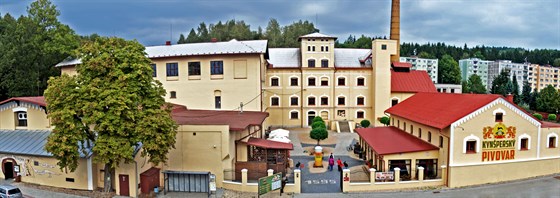


The brewery is located near the Ohře River in the northern part of the town of Kynšperk nad Ohří, which was first mentioned in writing in 1232.
The history of brewing in Kynšperk is also very old. In the historical annals we read that some towns of the former Loket region, including Kynšperk, complained in 1547 that the nobility forbade their subjects to take bourgeois beer. From this it can be concluded that beer was brewed in Kynšperk as early as the first half of the 16th century.
The real history of brewing begins in 1579, when Kynšperk received the brewing right from Emperor Rudolf II. This right was confirmed by the emperor in 1595. The year 1595 can be considered the year of the beginning of beer brewing in Kynšperk.
In 1603, the town of Kynšperk gradually took over the property of Kašpar Belvic of Nostvice, including the manorial malt house. A new brewery was built on the site of the current brewery in 1620.
As a result of the confiscations after the White Mountain, the property of Kynšperk, including the brewery, was acquired by the Metternich family, who ruled here until 1734. In the first half of the 18th century, the Kynšperk brewery was one of the 10 largest breweries in the Loket region with an exhibition of more than 1300 hectolitres of beer per year. In the ensuing hundred-year period, the owners often changed. In 1840, a new history of the brewery began under the leadership of the Haas family of Hasenfesl, who owned the brewery until 1945.
In the sixties of the 19th century, the brewery was expanded and equipped with a machine drive. The capacity of the brewery was ten thousand hectolitres of beer per year. The brewer at that time was Kašpar Krämling, from an important Cheb malting family. In 1875, the brewery produced 21,429 hl of beer. Krämeling’s successor was Albert Haberzettl, another famous brewer, during whose tenure 24,054 hl of beer was produced in 1882/1883.
The development of the brewery in the second half of the 19th century was contributed by the construction of a railway connecting Karlovy Vary, Sokolov and Cheb. Thanks to this, beer could be delivered to more distant places. At the same time, small village breweries in the vicinity of Kynšperk (Mostov, Lítov, Kaceřov) disappeared, which could not compete with the modern Kynšperk brewery.
At the turn of the 19th and 20th centuries, the brewery was completely rebuilt. Only the malt house and cellars remained of the original brewery. The appearance of the brewery corresponded to the industrial architecture of the time and you can still see some of its elements today.
The brewery also had modern technological equipment. The brewhouse was a six-vessel brewhouse with boilers heated by steam. The capacity of the brewhouse was gradually expanded from the original 112 hl to 150 hl of wort. It was expected to expand to 200 hl of wort. The brewery cellars had an area of 1,145 m2 and there were 170 wooden barrels with a capacity of 30 and 50 hl. The fermentation room was equipped with concrete vats. The malt threshing floor had an area of almost 1,000 m2 and was able to process up to 80 wagons of barley per campaign.
In 1911, the brewery was connected to the water supply. The construction of the modernized brewery was projected for 80,000 hectoliters of beer per year. At that time, 62 workers and 8 clerks were employed in the brewery. Josef Kiesse was appointed the brewery administrator. The brewer behind the entire modernization was Josef Hackl, who worked in the brewery until 1925. The function of the brewery administrator was replaced by Karl Heinrich. In the production year 1911/1912, the largest number of beers in the entire history of the brewery was produced. A total of 56,520 hl of beer. The basis of production was draught beer. Lager and probably dark beer were also brewed. The Kynšperk brewery was the largest brewery in the Sokolov (Falknov region).
During World War I, beer production fell to a tenth of the record production. In 1917/1918, only 5,071 hl of beer was produced. At the beginning of the twenties of the 20th century, beer production gradually went up. At the end of the twenties, it reached the pre-war production. The brewery was modernized again. The biggest novelty was the installation of a bottling line. In 1925, Bedřich Watzka from Stříbro was appointed as the new brewer, who was replaced by Karel Mörl in 1937.
During World War II, Viktor Schebrlle, Kryštof Schmid and František Dietl took turns as administrators. The former brewer Hackl was also a short-term brewer. During the war, the brewery was supervised by Valter Petschinka.
At the beginning of the 20th century, Olga Hassová ruled the property and then her son Jiří Haas, who shot himself in 1945 at Bítov Castle.
After the liberation of Czechoslovakia, it was confiscated as a German estate with a brewery in 1945 and the national administrator Eduard Petřík, who was also a brewer, was appointed to the brewery. I was assisted by the elder Karel Kašpar and the malt master Jaroslav Marek. The second administrator was appointed Václav Tůma, a clerk who had previously been the director of the Novopramen brewery in Brno and in Chlumec nad Cidlinou. The production of the brewery was constantly decreasing. It was around 30 thousand hl of beer. In 1947, the brewery was handed over to the administration of the Sokolov Regional Brewery as the District Kynšperk Brewery. After the revision of the brewery on April 17, 1948, the Commission of the Association for Hops, Malt and Beer stated the unfortunate management of the national administration. The brewery was found to be unpromising and preference was given to Cheb and Karlovy Vary beer.
At the end of 1948, the brewery became the property of the town of Kynšperk as a municipal enterprise. However, it continued to be subordinate to the district authority – the Joint District Administration of Municipal Enterprises in Sokolov.
In July 1951, the Ministry of Food Industry concluded an agreement with the Ministry of the Interior “On the cleaning of production programs”. According to this agreement, municipal enterprises subordinate to the Ministry of the Interior were not to operate some branches of production, e.g. beer brewing. On 4.7.1951, the national enterprise Chebskokarlovy Breweries began to take over the Kynšperk brewery. At the same time, it was decided to liquidate it. On 30.12.1951, the brewery was closed with the exception of the malt house. In 1952, the buildings were assigned to the basic plant in Cheb, the brewery’s machinery was divided into the plants Cheb, Chodová Planá, Karlovy Vary, Prunéřov, Petrohrad, Loket and Aš. The brewery equipment was taken away and warehouses were created from the buildings.
A new chapter of the brewery in Kynšperk began in 2010 when the entire brewery complex was bought by Absolut Active s.r.o. Prague. Gradually, a complex will be built under the name “Kynšperský dvorec”, which will include: Brewery with a capacity of 5000hl with the possibility of its expansion.
A brewery restaurant with a capacity of 100 seats in the vaulted area of the former malt house and 48 seats in the winter garden. The restaurant also includes a lounge. In the future, a hotel with a capacity of 100 beds with a wellness and relaxation center will also be built in the area.