

The name of the town is derived from the personal name of the founder of the local castle, Prince Břetislav. The German name Břeclav – Lundenburg – most likely hides the name of the Slavic tribe of Lovětic, living in the vicinity of the local Slavic fortified settlement, which in older times was probably called Lovětínhrad – Lauentenburch. The official name after the establishment of the First Republic was Břeclav, but after the occupation of the city in 1938 , only the German name Lundenburg was used. After the liberation in April 1945 , the town returned to its Czech official name Břeclav.
The beginnings of the town date back to the 11th century, when a border castle was built on the site of today’s castle after 1041 , which protected the entrance to the country from the Austrian side. The first written mention of Břeclav in the Latin form Bretyzlawe dates back to 1046, when the Stará Boleslav chapter received half a hryvnia and one ox from this place.
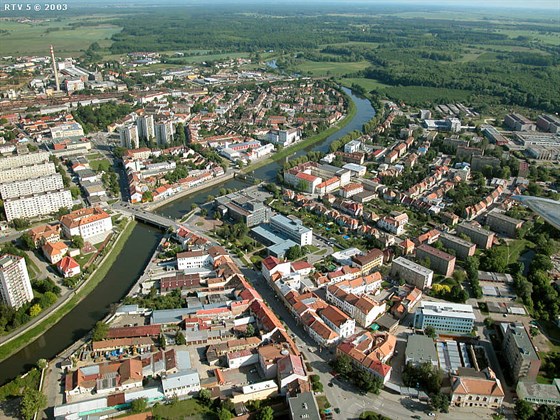
The bailey, from which after the middle of the 15th century developed a later town called Nová Břeclav in contrast to the old settlement, lay on an island formed by two branches of the Dyje River. The core of the bailey was a triangular marketplace, inhabited around the perimeter by craftsmen and people serving at the castle, with roads running to Poštorná, Stará Břeclav and Lanžhot.
In the 13th century, the castle was stolen from the landlord’s possession and passed as a fief or pledge into various hands. At the beginning of the 15th century, the Liechtensteins acquired Břeclav as a fief. From 1426 , there was a Hussite garrison at Břeclav Castle. After the Hussite wars, Břeclav and the entire estate were again acquired by the Liechtensteins, but even this time they did not keep the Břeclav estate.
In 1527 , the Žerotín family became the owners of the Břeclav estate, who bought it in 1534 . During the Žerotín family, the old castle was rebuilt into a Renaissance chateau.
The relative calm of the second half of the 16th century, in which members of the religious sect of the Neo-Baptists and the Unity of the Brethren appeared in Břeclav, was threatened at the beginning of the 17th century by Turkish expansion and the resistance of the Hungarian magnates against the Habsburgs.
However, the cataclysm of the Thirty Years’ War, which was the most terrible and tragic period in the history of the early modern history, not only of Břeclav, was about to take place. The flourishing Břeclav region with its extensive religious tolerance, which brought here the flourishing of agriculture, crafts and science, turned into a devastated landscape within three decades, from which half of the population disappeared and the restoration of which lasted the entire next century. The owner of Břeclav and the entire estate, Ladislav Velen of Žerotín, was the leading leader of the rebellious Moravian estates, so it is not surprising that in the way of fighting at that time, in which the enemy tried to undermine the economic power of the opponent by plundering, Břeclav was attacked several times in the initial phase of the war. After the lost Battle of White Mountain, the entire estate was confiscated and heavily destroyed was bought in 1638 by Karel Eusebius of Liechtenstein.
The post-war restoration was lengthy, because even in the second half of the 17th century, there was a war with the Turks in the Břeclav region. The 18th century was not without conflict for Břeclav either, because the Prussians got here, for example, in 1742, when Břeclav was burned down by the carelessness of a hussar lighting a pipe.
The decisive turning point for Nová Břeclav came in the 19th century. In the thirties of this age, both insignificant agricultural towns had 2,952 inhabitants. However, when the construction of a railway from Vienna to Břeclav and further to Brno and Olomouc began in 1836 , it marked the beginning of unprecedented development for Nová Břeclav. The first train, which arrived in Břeclav on 6 June 1839, was welcomed by the local farmers as a “devil’s enterprise”, but soon the railway brought a large influx of population and enabled the establishment of a number of important timber and food factories. These gave the local inhabitants job opportunities and attracted more and more inhabitants here, so on September 12 , 1872 , Břeclav was promoted to a town.
At that time, however, the leadership of the city was already held by the Germans, who promoted the German element against the Czech one both in the field of administration and in the economy and culture of the city. After 1870 , thanks to the Czech intelligentsia that settled in the city, the Czech element also began to raise its head. And so, when the First World War ended, the Czechs of Břeclav immediately declared themselves to be part of the newly emerging Czechoslovak Republic. However, it took until November 10 , 1918, for the situation to calm down and the city leadership passed into Czech hands.
In the new republic, the city continued to develop due to its border location, but on October 8 , 1938 , it was occupied by the German armed forces and annexed to the Lower Danube County in the Mikulov Landrat. The town, in which, according to the 1930 census, 11,220 Czechs, 1,582 Germans and 432 Jews lived, it was occupied along with Stará Břeclav. After the occupation, five to six thousand people left Břeclav and had to go inland. Many of them never returned. Among them were Jewish fellow citizens who disappeared in the concentration camps of the Third Reich.
Břeclav experienced the horrors of war on November 20 , 1944, when the city center and the district called Dubič were heavily bombed at noon. The liberation took place on April 13 – 17 , 1945. In the period after 1948 , the chemical and engineering industries were systematically built in Břeclav and the building materials and wood industries were developed, which were to change the somewhat one-sided orientation towards the food industry. On the other hand, however, a number of small trades were liquidated, which greatly weakened the economic life of the city (Kordiovský – Danihelka 1999)