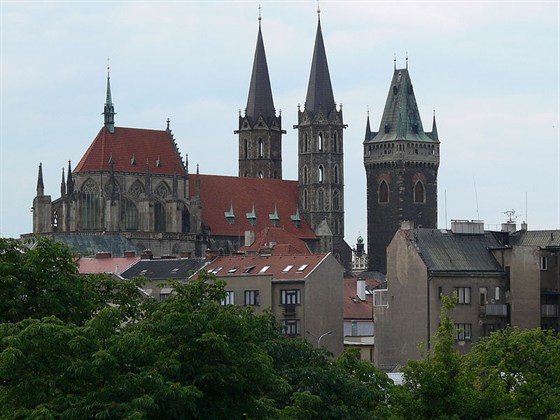

The fertile Elbe lowland on both banks of the Elbe is the town of Kolín. Rich archaeological finds from the town and its immediate surroundings prove that this place was inhabited long before the preserved written documents are confirmed.
In the district regional museum there are numerous monuments of all the settlements in Bohemia known to date. There used to be an ancient crossroads of three important trade routes established since the times of the Roman Empire. The presence of the Slavs can be documented as early as the 6th century AD. In the 9th – 12th centuries, this area was already densely populated, as evidenced by numerous finds of fortified settlements and burial grounds. The first written document with the name of Kolín is dated September 8, 1261. In 1437, Frederick of Strážnice built a castle on the site of a demolished monastery, which was later rebuilt into a chateau. Many privileges granted to the town by the Czech rulers Charles IV and Wenceslas IV supported the development and wealth of the town. At that time, Kolín was one of the most prominent cities in the Czech kingdom. The greatest humiliation and misery occurred during the Thirty Years’ War, which brought the city to the brink of destruction.
Kolín (German: Kolin, or Köln an der Elbe) is a district town in the east of the Central Bohemian Region on the Elbe River. It has over 30,000 inhabitants and an area of 35 km² with an average altitude of 220 meters. It is an important railway junction. There are chemical, automotive, engineering, food and printing industries.
The name Kolín probably comes from the Old Czech word “koliti”, i.e. “to hammer stakes, stakes”, and is related to the location of Starý Kolín in the often flooded area at the confluence of the Klejnárka and Elbe rivers, in the vicinity of which the soil was strengthened with the help of wooden poles. Later, a more advantageous location was chosen for the developing market settlement on an elevated place 7 km to the west. The new settlement (and later the royal town) retained the name of the original settlement.
There are other, less likely interpretations. The name could also be derived from its location on an elevated place, a hill – Latin for “colinus”, which, however, is in contradiction with the existence of Old Cologne. According to another theory, the Latin form of Colonio is related to the arrival of German colonists to Bohemia.
In the spring of 2005, the Toyota-Peugeot-Citroën (TPCA) consortium car factory was opened on the northern outskirts of the city, employing 3,000 people, with a production capacity of 300,000 cars per year. The first model is the trio of Toyota Aygo, Peugeot 107 and Citroën C1, jointly developed and 92% identical, launched around mid-2005.
From the chemical industry, it is Draslovka in Kolín, Lučební závody and the PARAMO refinery (formerly KORAMO).