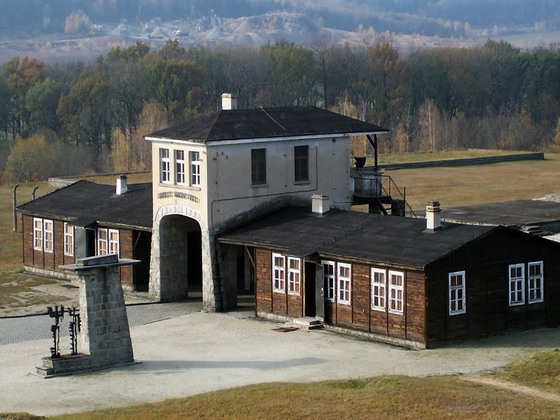


The Gross-Rosen concentration camp was established in the summer of 1940 as a subcamp of the Sachsenhausen concentration camp. It became independent in May 1941. It was built near a quarry, where prisoners then also had to work under inhumane conditions. Gross-Rosen was also the main administrative center for several other smaller camps. Most of the prisoners in the Gross-Rosen concentration camp, about 50,000 prisoners, were Jews transported from the concentration camps of Dachau, Sachsenhausen and Buchenwald. They came mainly from Poland and Hungary, but also from Belgium, France, the Netherlands, Greece, Yugoslavia, Slovakia and Italy. Some of the prisoners were arrested and sent to a concentration camp on the basis of Adolf Hitler’s order “Nacht und Nebel” (English: Night and Fog), which determined the way in which the arrested in the Third Reich and the resistance leaders in the occupied territories were treated. This meant the abduction of people in the middle of the night (Nacht) and their disappearance without any information to their relatives (Nebel).
According to available data, a total of about 125,000 prisoners passed through the camp. Of these, a full one-third died as a result of brutal treatment either during transport, directly in the camp or in the quarry. Sadistic violence against political and Jewish prisoners was perpetrated by SS members and German civilians who worked in the quarry. Living and working conditions were even more cruel than in other camps. Hard work and very small food rations, a complete lack of hygiene and the denial of medical care caused an extremely high mortality rate. In 1942, the average survival time for a prisoner was less than two months. Approximately 500 female camp guards were trained in the Gross-Rosen concentration camp. SS women then worked in subcamps, such as Brunlitz (Brněnec), which was the place where Oskar Schindler moved the Jews whose lives he saved. In 1945, when the end of the war was approaching, 100,000 prisoners were placed directly in the camp. A large part of them were women, Jewish. Before the Nazis withdrew from Polish territory, they managed to organize one of the most tragic death marches. Almost all prisoners, if they did not die or were not killed on the way, were transferred to other camps, mostly inside Germany. In these camps, most of the people subsequently died. Very few people were found alive in the camp after the liberation in February 1945.