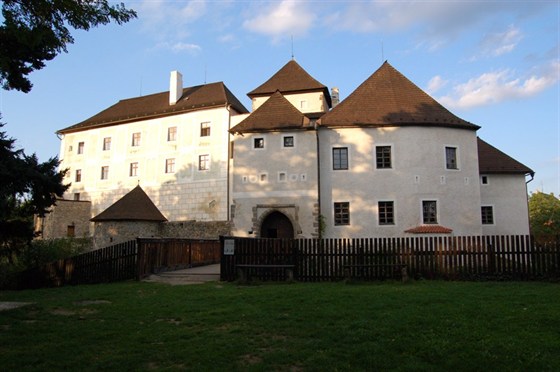


Nové Hrady Castle was built on a promontory surrounded by the Stropnice River and the Novohradský Stream, probably in the first half of the 13th century. The first written mention dates back to 1279, when the castle was the property of Vítkovec Ojíř. In 1359, the manor was bought by the brothers Jan, Petr, Jošt and Oldřich of Rosenberg. Of these, only Oldřich stayed here for a long time. Other Rosenbergs mostly inhabited the castle only temporarily. It then served as the center of the Novohrad estate, which was one of the largest Rosenberg estates, and also as an important military stronghold point. During the Hussite wars, the castle was burned down by the Tábor hetman Jan, called Bzdinka. In 1579, during a storm, gunpowder stored in a massive cylindrical tower standing in the eastern part of the courtyard ignited from lightning, the subsequent explosion shattered the tower and damaged the surrounding buildings. The destruction was completed in 1590 by a relatively strong earthquake. The castle was badly damaged and even considered demolishing it. In the end, only the ruins of the massive bergfrit and probably also the closely adjacent palace were destroyed. The rest of the castle complex was repaired and newly fortified according to the designs of the Italian architect Antonio Canevalle. With the death of the last Rosenberg, Petr Vok, in 1611, the manor passed into the property of the Lords of Švamberk on the basis of an inheritance contract.
Peter of Švamberk actively participated in the uprising of the estates (1618-1620) on the side of the estates. Therefore, the castle was besieged by the imperials: first by General Dampierre and in June 1619 by General Buquoy, who also conquered the castle. By a document dated February 6, 1620, Karel Bonaventura Buquoy received the estates of Nové Hrady, Rožmberk and Libějovice from the emperor for his merits and as redemption of debts. Shortly after, during the subsequent campaign to Hungary, Karel Bonaventura was shot during the siege of Nové Zámky.
His wife Maria Magdalena of Biglia, living in Belgium, first appointed administrators, brothers Gerhadt and Filip van Stratten, to the Novohrad estate. After becoming convinced of their unreliability, she moved permanently to Bohemia in 1623. She had a comfortable residence built on the Novohrad square on the site of the manor houses (habitable since 1635). The Buquoys resided here until the beginning of the 19th century, when a new Empire chateau was built on the north side of the town.
Novohrad Castle thus definitively lost its residential role and was used in this period for the housing of manorial officials, as a forest administration and for other economic purposes. At the end of the 18th century, the upper part of the north-eastern tower was added, where the Buquoy family archive and library were stored.
At the end of World War II, the Red Army established a headquarters in the castle and part of the archival materials was destroyed.
Based on evidence of the collaboration of the last owner, Karel Jiří, the Buquoy estate was confiscated and handed over to the care of the state. In the fifties of the twentieth century, an exhibition of mainly hyalite glass was established in part of the castle, the rest continued to serve as apartments and later also as a folk art school and cultural center. In the eighties, the castle underwent extensive reconstruction. In 2000, a new exhibition was built and in 2002 the castle passed into the administration of the State Heritage Institute, today the National Heritage Institute.