

Radhošť is the most famous mountain in the Beskydy Protected Landscape Area. It measures 1129 meters and offers beautiful views of the entire Beskydy Mountains, Wallachia, the Jeseníky Mountains – Praděd, the Malá and Veľká Fatra.
Radhošť is often associated with the worship of the pagan god of hospitality, fertility and harvest Radegast. According to legends, this god, the god of the sun, war and victory, used to have his residence on this sacred mountain. According to legend, his idol on the top of the mountain was demolished by Thessaloniki missionaries Constantine and Methodius after their arrival in Great Moravia, when they allegedly visited Radhošť in the sixties of the 9th century. It is said that his idol was stored in an underground temple.
The massif of the mountain is interwoven with pseudo-karst sandstone caves, up to several hundred meters long. According to one of the legends, at the beginning of the century they were so spacious that a horse-drawn wagon could drive through them from Pustevny to Radhošť.
The ancient Slavs celebrated the summer solstice in Radhošť.
Since the sixties of the last century, Cyril and Methodius pilgrimages have been held in Radhošť at the beginning of July, which are attended by several thousand people.
Radhošť attracted muses with its mysterious charm. The Radhošť past was sung in verses by František Palacký, Jan Kollár and František Táborský. The mountain became a grateful subject for the artists Bohumír Jaroněk and Jan Kobzáň. The mountain was also personally visited by poets Svatopluk Čech, Petr Bezruč, Otakar Březina and Jaroslav Seifert. In 1931, the sculptural works of the Czech-American Albín Polášek were installed in Radhošť: a bronze sculpture of Cyril and Methodius near the chapel and a statue of Radegast near Pustevny. It was deliberately turned with its back to the newcomers, while the Cyrillo-Methodian sculpture stands facing to welcome visitors to the Radhošť peak.
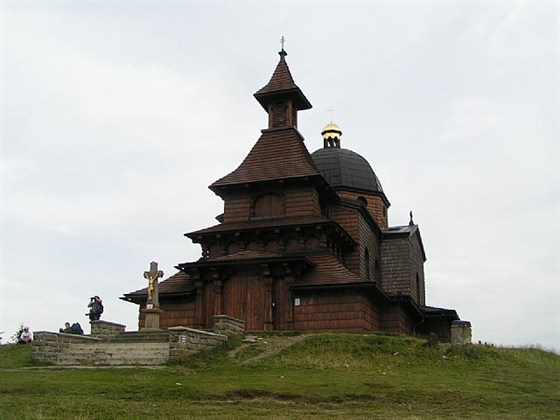
Nowadays, there are several interesting places at the top, such as the Chapel of St. Cyril and Methodius, the sculpture of both missionaries, a cross and a television transmitter.