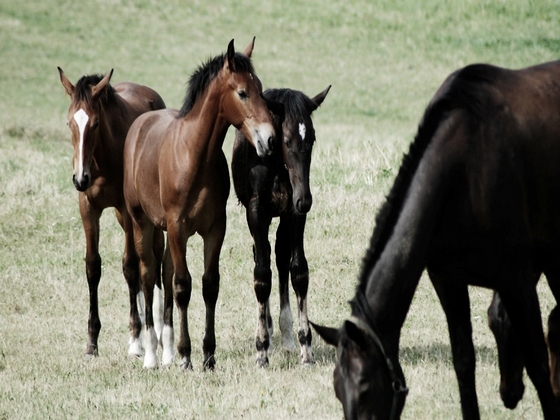


The history of today’s breeding facility begins at a time when Książ Castle in the then Kingdom of Prussia belonged to the von Hochberg family.
Konrad Ernest Maximilian was the first to devote himself to horses. He had two buildings belonging to the castle converted into a stable and an indoor riding hall. However, the horses later left them – and went to the newly built stables.
John Henry XV was a great fan of horses, among other things, the man who contributed to the holding of the first Silesian cross country in June 1907.
No wonder – he was the real son of his father, John Henry XI, a royal hunter, organizer of imperial hunts and director of the imperial hunting office in Berlin.
The still existing complex of buildings from the 19th century fulfilled the function of castle stables until the 1930s. East Prussian, Traken and especially Oldenburg horses stood here. The administrator of the stud farm was an Englishman, Alexander Stewart.
In 1935, the stable buildings together with 80 acres of land for debt became the property of the then Land of Prussia (Land Preusssen), part of the German Reich. On April 1, 1939, the youngest “Prussian herd” was established, named Fürstenstein, of course. In 1945, it was decided to evacuate the stallions to the Saxon stud farm Moritzburg. Their transfer began on March 5, but the Protectorate of Bohemia and Moravia eventually became the final destination. Unfortunately, the operation completely failed and all the horses were “acquired” by the Red Army. During the war, horse breeding was almost completely destroyed
in Lower Silesia. A large part of the population died, some were evacuated, and the rest “ran” all over Poland.
The Książ herd has five stables at its disposal, each original (there are boxes and stalls), some more
with its original decoration. The most representative and functional of them is stable number III, currently used
during auctions, championships and other major events. There are a total of 28 berths in two rows.
Stable IV, restored after a fire in 1998, is now intended for pregnant mares and mothers with foals.
Originally, it was wooden, with a burnt brick floor. Until 1936, 36 carriages were parked in it. It had stables for 68 stallions, sorted according to coloration.