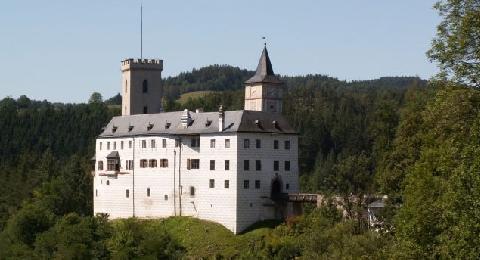


The castle was built on an important trade route leading from Bohemia through the Vyšší Brod Pass to the rich upper Danube region. With the original German name Rosenberg, it was first mentioned in 1250 during the reign of King Wenceslas I.
During the lifetime of the probable founder of the castle, Vok von Rosenberg, and his closest descendants, the castle was the dwelling of the ruler and the center of the estate. Despite its advantageous strategic location, the castle was conquered several times. In 1551, the family estates were ceded to the sixteen-year-old Wilhelm von Rosenberg. The beginnings of intensive construction activity at Rosenberg fall into this period. This period is also one of the most famous in Rosenberg history. After his death in 1592, Petr Vok took over the estate, during whose reign some of the interiors of the castle were modified under the influence of the Italian Renaissance. In 1601, Petr Wok ceded the Rosenberg estate to Jan Zrinsky, who lived here until his death in 1612. The new owner had generous modifications made to the interiors in the spirit of Mannerism. The Gothic castle became a comfortable Renaissance residence. The turbulent events at the beginning of the 30th Years’ War caused that Rožmberk Castle found itself in the hands of the imperial general Karel Bonaventure Buquoy in 1620. The castle was in the possession of the aristocratic Buquoy family until 1945. Jiří Jan Jindřich Buquoy (1814 – 1883) was a passionate collector of art and historical objects. In the spirit of the romantic feeling of the 19th century, he implemented a grand plan and rebuilt the Rosenberg into a family museum. Extensive building modifications were carried out in the style of romanticizing Gothic and the appearance of the castle changed radically. The castle, which thus received its final form, was opened to the public.