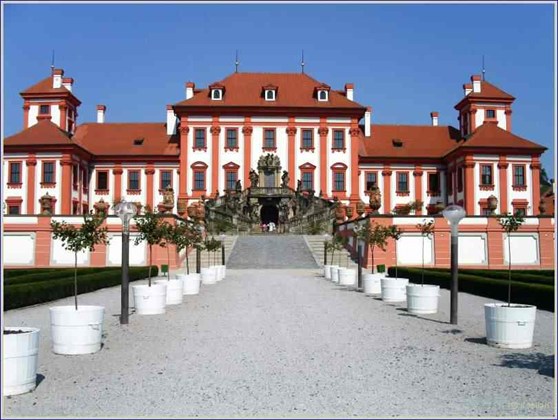


Václav Vojtěch, Count of Šternberk, had his summer residence built in 1679. He thus sought to obtain the title of nobility, which he succeeded in. Troja Castle is one of the most important examples of 17th-century castle architecture in Bohemia in general. Count Šternberk invited outstanding European artists to build and decorate it. The building was designed by Giovanni Domenico Orsi, who was soon replaced by Jean Baptiste Mathey, who changed the original concept to a very regular layout with the main hall in the middle. The main hall was connected to the garden by a monumental garden two-flight staircase, to which Jiří and Pavel Hermann of Dresden were invited in 1685 to decorate the sculpture. Around 1705, they were supplemented by Jan Brokof. The staircase is decorated with sculptures of ancient gods and goddesses depicting their fight with the Titans, as described in the ancient Greek Iliad. This is probably where the name Troy comes from, which then spread to the entire area.
The ceiling and walls of the central hall are covered with frescoes with the theme of the Apotheosis of victory over the Turks near Vienna, thus celebrating the Habsburgs. The frescoes were painted by Dutch painters Abraham and Isaac Godin. The adjacent rooms were decorated by the Italian painter Francisco Marchetti and his son Giovanni with frescoes with themes of ancient mythology and a celebration of the castle’s builders. There are a total of 4000 m2 of paintings in the castle, of which 1400 m2 are in the main hall, which is also used for concerts. The castle, sensitively set in the landscape, is surrounded by a large French garden decorated with terracotta vases, stucco prospects and orangeries with busts of emperors.
Back to map
Locks
Troja Castle
Location photos
Explore the location