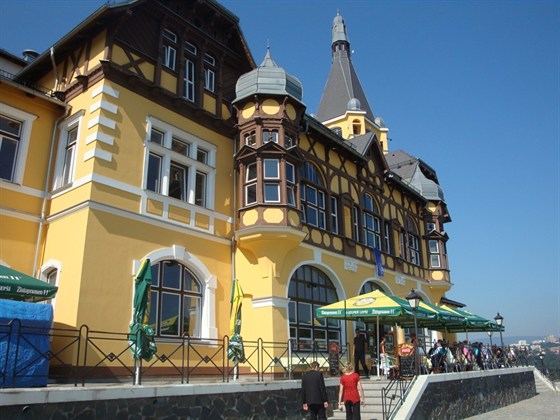


According to legend, there used to be a castle called Větruše above the confluence of the Elbe and Bílina rivers. It was built in 826 by the knight Labohoř and named Vitruš / Wittrusch in honour of his wife.
In the 19th century, one day, the tenant of a house on Větruš, Johann Thomas, was looking for a spring for a well, uncovering the thick foundation walls of the castle. In the same year (1839), he handed over to the municipality a building plan for the beautification of the Soudný vrch with beautiful views in three directions of the Elbe valley and the ring of the surrounding hills. This whole complex was to serve the population for relaxation and entertainment. This place with a small inn and a dance floor was named Ferdinand’s Height (Ferdinandshöhe) in memory of Emperor Ferdinand.
Later, members of the Gebirgsverein Aussig tourist association began to deal with the idea of acquiring the building with all the premises. They did not only pursue the association’s own needs, but were mainly concerned with the public benefit, so that Větruše could continue to serve the population as a park for children’s games and folk festivals.
The greatest wish of the inhabitants was to build a new restaurant building, which would become a decoration of the town. The foundation stone for the new property was laid on October 15, 1896. On October 7, 1897, the last stone in the northern wall of the hall could be ceremoniously laid. Over the years, Větruše has become a place of rest and entertainment for thousands of people. Singers and trainees performed on the landscaped meadow, festivities of all associations and unions were held, and theater performances were performed here. Not only when traveling by boat or train, it became a symbol of the city and the center of the social and social life of the inhabitants of Ústí nad Labem.
After 1945, the old Czech name Větruše returned to the hill, which was also transferred to a restaurant. It continued to live with social activity until the end of the sixties. However, in the period after World War II, it often changed operators, which turned out to be a brake on its further functioning. Later, its decline began, which was finally crowned by the unfortunate privatization in the nineties. The building changed owners and the citizens of Ústí had to watch the building – left to its fate – quickly deteriorate. The fateful date was July 13, 2000, when a fire engulfed the roof of the lookout tower.
In 2001, however, there was a favourable turn. The Ústí patriots pushed for its purchase back into the property of the city and the following year repairs began. Since September 23, 2004, it has been open to the public again.
CMQC recommends:
In the immediate vicinity of the lookout tower you will also find an attraction in the form of a mirror and natural maze, a children’s playground and a sports ground