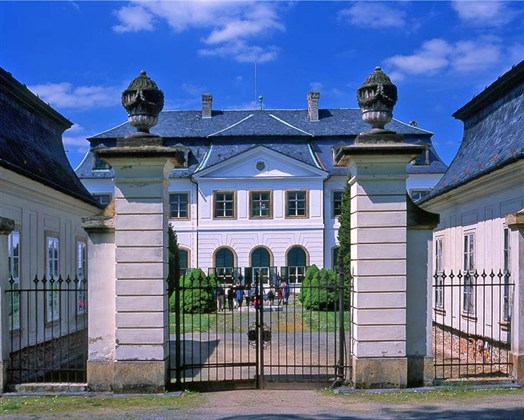

The Náměšť na Hané Chateau was built in the 18th century in the most modern style of the early Classicist Baroque with French architectural influences. The chateau stands in the middle of a circular park, from which linden alleys protrude to the four cardinal directions.
In 1726, the Harrach family, who belonged to important families of the Habsburg Empire, bought the Náměšť estate. The Lower Chateau served as their residence. After the end of the Seven Years’ War, Count Ferdinand Bonaventure of Harrach began
with the construction of a new chateau (the foundation stone was laid on 1.3.1766) near the ruins of a medieval castle. The new summer residence was built in the most modern style of early Classicist “Moravian” Baroque with French architectural influences. The new chateau was called the Upper Chateau. The former seat is the Lower Chateau (today the Malt House). At the same time as the chateau, a circular park was created, which is connected to the four cardinal points by linden alleys with a circular path. The last major modifications were carried out in 1925 by the landscape architect Křemen. Its layout ranks among the most important buildings in Moravia. North of the castle, on the site of the old castle chapel, the Chapel of the Holy Trinity was built in 1672, which was consecrated in 1722. Today’s Empire chapel has a 1834 appearance.
An important building connected with the history of the castle is also the tomb of the Kinský family, which they had built in 1871 at the newly founded cemetery in Náměšť. The tomb is built in the Empire style and above the crypt there is a chapel with a wooden altar. Three generations of the Náměšť Kinský family are stored in the tomb. In 1778, after the death of Count Harrach, the castle was inherited by his daughter Marie Róza, Countess Harrachová, who had been married to Count Josef Kinský since 1777. The Kinský family, like the Harrachs, were one of the most prominent families in the empire and lived in Náměšť for 124 years. The last Kinský of the Náměšť branch, Eugene II, sold the castle to František Ottáhal, an iron wholesaler, in 1916. Mr. and Mrs. Ottáhal had the chateau modernized. After the death of František Ottáhal, in 1943, his wife and children inherited the chateau.
On June 17, 1945, the property of the family was confiscated according to the Beneš Decrees. It was one of the first confiscations in ČSR.Do end of 1999 the chateau was administered by the Museum of National History in Olomouc, from January 1, 2000 to June 30, 2000 by the SSHZZSM (Administration of State Castles, Chateaus and Gardens of North Moravia). Since July 1, 2000, the chateau has been the property of the Township of Náměšť na Hané.
On June 17, 1945, the property of the family was confiscated according to the Beneš Decrees. It was one of the first confiscations in ČSR.Do end of 1999 the chateau was administered by the Museum of National History in Olomouc, from January 1, 2000 to June 30, 2000 by the SSHZZSM (Administration of State Castles, Chateaus and Gardens of North Moravia). Since July 1, 2000, the chateau has been the property of the Township of Náměšť na Hané.