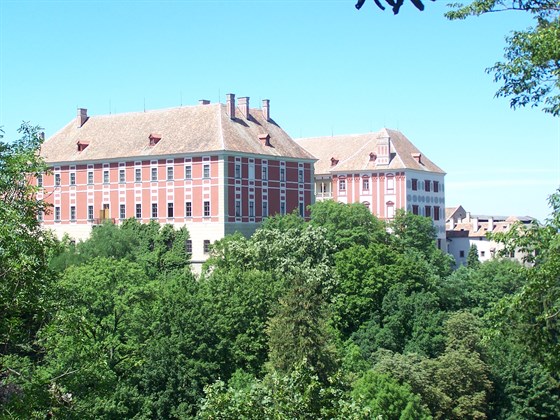


The Renaissance chateau above the valley of the Golden Brook was built on the foundations of a Gothic castle by the Czech aristocratic family Trček of Lípa in the 2nd half of the 16th century. In the 17th century, the chateau was acquired by the Colloredos family, who modified not only the interiors of the chateau, but also the economically used valley into a landscape park with romantic buildings. The most attractive parts of the chateau collections include a collection of weapons and a picture gallery with works by Venetian and Neapolitan masters of the 16th and 18th centuries.
Castle
The chateau built by the aristocratic Trček family of Lípa was built during the second half of the 16th century. The generosity of the concept and considerable family property were a prerequisite for the construction of a large complex, developed around the main chateau building with three floors of arcaded loggias open to a rectangular courtyard. The events of the Thirty Years’ War, together with the penetration of new social forms and building styles, influenced the appearance and ownership of the complex. For the Colloredo-Mannsfelds, the need for presentation became the main force influencing the events in the chateau. The interiors were modified in the spirit of the European aristocratic environment, the economically used valley was replaced by a newly established natural landscape park with romantic buildings. Despite all the changes that the chateau complex has undergone, it has retained its enormous historical and artistic value, as well as considerable charm and charm.
Sightseeing tours:
-
ethnographic hall, historical interiors, picture galleries, library + oriental armoury, hunting hall, armoury
-
ethnographic hall, historical interiors, picture galleries, library
It is also possible to visit the castle park and occasionally accessible areas of the castle.
History
The area of the Opočno chateau was built on the site of a medieval castle, which stood here according to the first written report in the Chronicle of Cosmas as early as 1068. During the Hussite wars, when the manor was owned by Jan Městecký, the castle was besieged by orphan troops due to the betrayal of its owner, conquered and destroyed in 1425.
In the following period, a number of owners changed in Opočno, which lost its importance, until 1495 the manor fell to the Trček family of Lípa. They belonged to the richest families in Bohemia, held high offices and built a representative family residence from Opočno by rebuilding the old castle into a Renaissance chateau.
The reconstruction was mainly due to Vilém Trčka, inspired by his stay in Italy in 1551 and the buildings of the Italian Renaissance. Its inner courtyard was equipped with arcaded galleries with slender Tuscan columns, the facades were decorated with sgraffito. In 1602, a ball room and a one-storey summer house became part of the chateau complex. In the 17th century, the Trčka family died out by the sword, when Adam Erdman Trčka together with Albrecht of Wallenstein was murdered in Cheb in 1634.
The Trček property was confiscated and Opočno was acquired by Rudolf Colloredo, an officer of the imperial army. At the turn of the 17th and 18th centuries, the Colloredos proceeded to the building modifications of the castle in the Baroque style, the presumed author of which is the builder Giovanni Battista Alliprandi.
In 1771, thanks to the marriage of František I. Gundakar Colloredo with Maria Isabella of Mansfeld , the family name of the owners was extended to Colloredo – Mansfeld and the estate of Opočno and Dobříš was merged. The Colloredo – Mansfeld family owned Opočno until World War II, after which it was confiscated. In the 19th century, the Opočno chateau was still structurally modified, when the wall in the courtyard connecting the side wings was torn down.