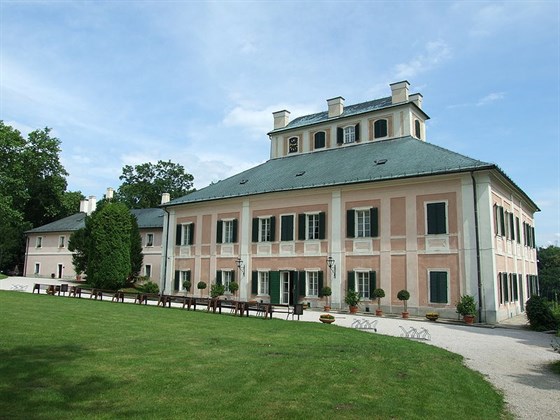


Ratibořice Castle is known mainly for the work Grandmother by Božena Němcová. It was here that the famous Kateřina Zaháňská – the princess of Grandma lived. The beautiful Empire chateau forms a dominant feature inextricably linked with Grandma’s Valley. Originally, it was a one-storey Baroque chateau with a chapel in the style of small Italian summer houses and summer residences. It was built in 1708 in the vicinity of a fortress from the 14th century by the owner of the Náchod estate, Vavřinec Piccolomini. In the 18th century, an extension was built – a one-storey wing that served for guests and servants. Other extensive reconstructions were carried out by Kateřina Zaháňská, who inherited the Ratibořice Chateau and the Náchod manor from her father, Duke Peter of Curon.
It was during her possession that the small Ratibořice residence became a place where the whole of Europe shook hands. At her summer residence, the princess hosted world personalities and the elite of society at the time – such as the Austrian Chancellor Metternich or the Russian Tsar Alexander I. In 1813, the walls of the Ratibořice castle were silent witnesses to a secret meeting of the anti-Napoleonic coalition of Prussia, Russia and Austria. The princess rebuilt the entire chateau into a modern-looking fashionable Empire residence. In addition, she set up a large English park and an exotic greenhouse in front of the chateau. The beautiful park turns into wild nature with meadow trees, forests and small paths and paths, alleys and bridges over the Úpa River. The whole complex forms a very picturesque complex today called Grandma’s Valley. In 1840, the Náchod estate, including Ratibořice, was bought by Karel Octavio of Lippe, but in 1842 he sold it to the Schaumburg-Lippe family. This aristocratic family managed the castle until 1945, when the seat passed into the hands of the state. During the Schaumburg family, the castle acquired a slight classicist charm. Take a look at the important mansion, which represents a typical elegant rural dwelling of the high aristocracy from the 19th century.