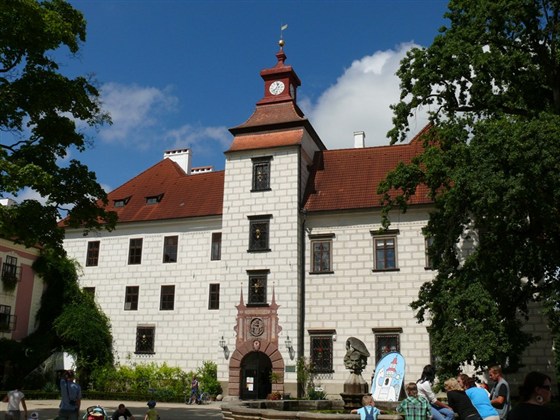

An inseparable part of Třeboň is a magnificent Renaissance chateau, located on the southwest side of the historic city center. In these places, there was first a manor house, turned into a fortress, and later a stone castle, mentioned for the first time in 1374. Not long before, Třeboň was bought by the Rosenbergs, who gave the town and its wide surroundings proper development. After 1562, Wilhelm von Rosenberg commissioned Jan and Antonín Ericery to rebuild the old castle buildings into a Renaissance chateau. This transformation was completed in the time of Petr Vok by the architect Domenico Cometa. After the death of the last Rosenberg (1611), the castle was inherited by the Švamberks, who lost most of their property after the fateful Battle of White Mountain. Emperor Ferdinand II donated the Třeboň estate to his own family, but no one took care of the easily acquired property and the salvation for the castle is only the transfer into the hands of the ancient German Schwarzenberg family, who acquired it in 1660. The princely Schwarzenberg family owned the castle until 1940, when it was occupied by the Gestapo. At the beginning of the twenties, after the first land reform, the Schwarzenbergs left the castle and then served as a hotel facility for several years. After the war in 1945, national administration was established over the castle and in 1947 the Třeboň castle was nationalized.
The chateau complex is entered from the square through the northern castle gate, built in the years 1605-1607 by Dominik Comet. The first historical exhibition called “Rosenberg Renaissance Interiors” documents and recalls the oldest history up to the 17th century. century. The second sightseeing route documents and recalls the way of life of the last princes of Schwarzenberg.
Of the chateau interiors, the most interesting is a large Renaissance room with a rectangular floor plan vaulted with a high mirror vault.